The Best Structured App Alternatives in 2026
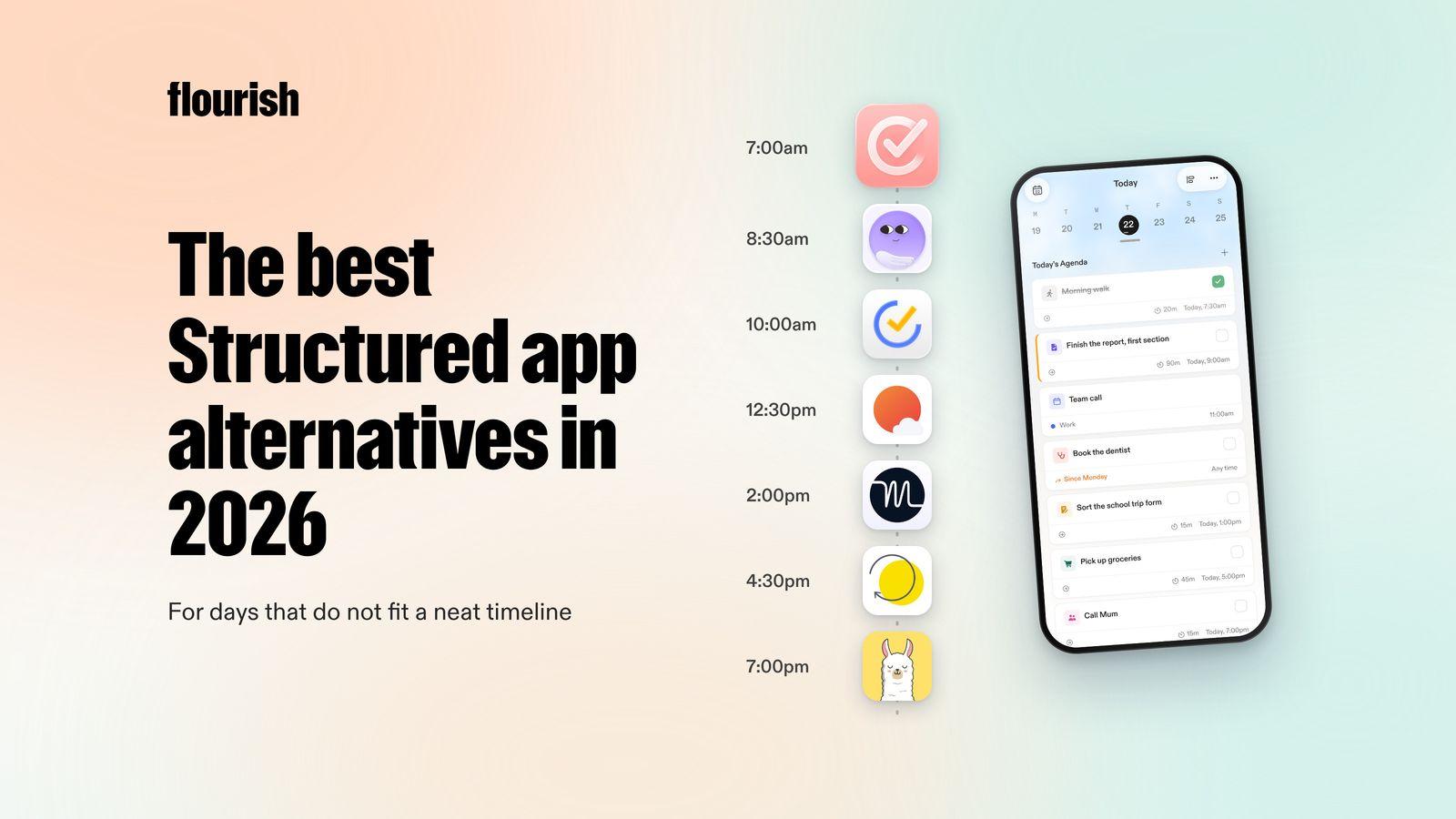
Seven Structured alternatives, grouped by why the timeline is not working: you need help choosing what goes on it, a more ADHD-friendly visual planner, an all-in-one app, AI that schedules for you, or routines that run themselves.
By Julian · · 10 min read
The short version
The best Structured alternative depends on what is going wrong with the timeline. If you open Structured and do not know what to put on it, or the plan falls apart by mid-morning, Flourish is our top pick: you talk through everything on your mind, it turns that into a prioritised list with one clear to-do for the day, and a coach checks in so it happens. For a visual planner built with neurodivergent people in mind, try Tiimo. For tasks, calendar, habits and focus in one app, TickTick. For a guided work-day ritual, Sunsama. For AI that schedules for you, Motion. For step-by-step routines, Routinery, and for one task at a time on a countdown, Llama Life.
Structured is a lovely app. It puts your tasks and calendar events on one timeline you can drag around, with week and month views, routines, a Pomodoro timer, widgets and Live Activities. Structured AI can turn a typed or spoken plan, or even a photo of a paper planner, into tasks on your timeline (Structured). People look for an alternative when that tidy timeline does not match the messy day they actually have. This guide is grouped around the reasons.
Why do people look for a Structured alternative?
Structured is excellent at showing a day you have already planned. It is less help with the harder part: deciding what goes in, and keeping going when the plan slips. In our experience, these are the most common reasons people look elsewhere:
- You do not know what to put on the timeline. Everything feels equally important, so you either cram it all in or leave it blank.
- The plan falls apart. One late meeting or a bad morning and the whole timeline is wrong, and replanning feels like starting again.
- Nothing nudges you. A beautiful plan is easy to ignore when nobody checks in.
- You want more than a timeline. Habits, focus time and long-term lists live in other apps.
- You want something designed around ADHD brains, with routines broken into steps and time made visible.

None of these mean Structured is bad. They mean the tool and the day do not match. If you want the wider picture first, our roundup of ADHD planner apps compares visual planners side by side.
Ranked: the best Structured alternatives in 2026
1. Flourish: best if you need help deciding what goes on the plan

Flourish is an AI coaching app for people with a million things in their head and no obvious place to start. Structured asks you to build the day. Flourish starts from the mess instead. You talk, and ramble everything on your mind. Flourish turns that brain dump into tasks, prioritises them and gives you one clear to-do for the day, which also shows on your lock screen.
Then the coach covers the part a timeline cannot. Flourish reaches out proactively to help you plan, to challenge what you are about to do next and to keep you accountable, so the day does not collapse the first time something runs over. It connects your calendar, wearables and Gmail inbox, so it plans around the day you actually have.
- Best for: people leaving Structured because they stare at an empty timeline, or a full one, and still do not know where to start.
- Platforms: iOS and Android.
- Honest limitation: it is not a drag-and-drop timeline, and it does not have a focus timer. If you love seeing every hour laid out, keep Structured for that and use Flourish to choose the priority.
Why it is our top pick: a timeline shows you when, but most hard days are stuck on what. One clear priority and a coach that follows up is often what turns a plan into a done task. If you want an app that reaches out first, our guide to AI accountability partner apps compares more options.
2. Tiimo: best visual planner built around ADHD brains
Tiimo is the closest like-for-like swap. It is a visual daily planner that says it was built by and for neurodivergent people, with a visual timeline, routines, a focus countdown timer, a brain-dump to-do list, mood check-ins and calendar import from Google, iCloud and Outlook (Tiimo). Its AI co-planner takes what you type or say, breaks it into steps, estimates times and builds a schedule.
- Best for: people who like Structured's visual style but want a planner designed with ADHD and autistic users in mind.
- Platforms: iPhone, iPad, Apple Watch, Android, Mac and web.
- Honest limitation: the Android app was rebuilt from scratch in May 2026, and some features, including the AI co-planner, were still listed as coming soon there (Tiimo). Our guide to Tiimo alternatives covers more options.
3. TickTick: best all-in-one app
TickTick puts to-dos, a calendar, a habit tracker and a Pomodoro timer in one app, with an Eisenhower Matrix, Kanban and timeline views. Its AI can create tasks from your voice and break a project into steps from one instruction (TickTick).
- Best for: people who want habits, focus time and lists alongside their daily plan, without juggling apps.
- Platforms: iPhone, iPad, Android, Mac, Windows, Linux, web and Apple Watch.
- Honest limitation: with so many features, it can feel busy, and you still choose the plan yourself. Our guide to TickTick alternatives covers what to try if it feels like too much.
4. Sunsama: best for a guided work-day ritual
Sunsama walks you through planning each working day: choose a realistic workload, timebox it and shut down at the end. It adds focus mode, a Pomodoro timer, weekly objectives and two-way sync with Google, Outlook and Apple calendars (Sunsama). Its assistant, Sunny, can build a draft day from a brain dump (Sunsama changelog).
- Best for: professionals who want their timeline to pull in tasks from work tools such as Asana, Jira, Notion and Todoist.
- Platforms: iOS, Android, Mac, Windows, Linux and web.
- Honest limitation: it is built around the working day, and the daily ritual takes effort. See our guide to Sunsama alternatives if that is the sticking point.
5. Motion: best if you want AI to fill the timeline for you
Motion does automatically what Structured asks you to do by hand. Its AI sets priorities from deadlines, durations and dependencies, time blocks tasks on a calendar that merges Google, Outlook and iCloud, and reschedules when things change (Motion).
- Best for: busy professionals with project-heavy work who want the scheduling done for them.
- Platforms: iOS, Android, Mac, Windows and web.
- Honest limitation: it is a full work platform with a lot to set up, and a calendar packed by AI can feel more pressured than a timeline you built. Our guide to Motion alternatives explains why some people leave.
6. Routinery: best for routines that run step by step
Routinery is a routine timer and habit tracker. You build a routine, such as getting out of the door in the morning, and it times each step, with a voice announcing what comes next. It tracks streaks and stats, offers ready-made routines including ADHD-themed ones, and its AI recommends routines from your history (Routinery).
- Best for: people who used Structured mainly for morning and evening routines.
- Platforms: iPhone, iPad, Mac, Apple Watch and Android.
- Honest limitation: it is for routines, not for the one-off tasks that pile up in between.
7. Llama Life: best for one task at a time on a countdown
Llama Life gives every task on your list its own countdown timer, so you work through one at a time and can see the total time and an estimated finish time. It adds soundscapes, alarms, Live Activities and the Dynamic Island, and its App Store listing positions it as an ADHD organiser (App Store).
- Best for: people who find a whole-day timeline too much and focus better on one task with a timer.
- Platforms: iPhone, with a web app.
- Honest limitation: it does not choose which task matters most, so you still need a way to decide.
Side by side
- Flourish: why switch: help deciding. Plans the day: picks one to-do. Follows up: yes, a proactive coach.
- Tiimo: why switch: ADHD-first visual planning. Plans the day: AI co-planner. Follows up: notifications.
- TickTick: why switch: everything in one app. Plans the day: you, with AI help. Follows up: reminders.
- Sunsama: why switch: a guided work day. Plans the day: you, with AI help. Follows up: daily shutdown.
- Motion: why switch: AI scheduling. Plans the day: auto-schedules. Follows up: re-plans as things move.
- Routinery: why switch: step-by-step routines. Plans the day: routines only. Follows up: voice prompts.
- Llama Life: why switch: one task at a time. Plans the day: you. Follows up: timers and alarms.

Which Structured alternative fits why you are leaving?
- "I do not know what to put on my timeline." Try Flourish. You talk, it chooses one priority, and the coach follows up.
- "I want a visual planner made for ADHD brains." Try Tiimo.
- "I want habits, focus time and lists in one place." Try TickTick.
- "I want my work tools in my plan." Try Sunsama.
- "I want the timeline filled for me." Try Motion.
- "I mostly need my routines to happen." Try Routinery.
- "A whole day is too much. I need one task at a time." Try Llama Life.
Two apps is usually the sensible maximum: one that decides what matters and one that lays it out. If you want to try a planning prompt first, our guide on how to use ChatGPT to plan your day shows how.
When is Structured still the right choice?
For some people, the best move is to stay. Structured is still a great fit if:
- You think in pictures and like to see every hour of the day laid out.
- You mostly know what you need to do and want a calm place to arrange it.
- You use Apple devices and want widgets, Live Activities and an Apple Watch app.
- You like being able to type, say or scan a plan and have it appear on your timeline.
If Structured mostly works but some mornings you cannot face filling in the timeline, you do not have to choose. Some people use Flourish to settle the one thing that matters today, then lay the rest of the day out in Structured.
The verdict
The best Structured alternative is the one that fixes the reason you are leaving. If the hard part is deciding what goes on the timeline, or keeping going when it slips, Flourish is our pick, because it turns a spoken brain dump into one clear priority and then checks in so it happens. Tiimo is the best visual planner designed for neurodivergent people, TickTick the best all-in-one app, Sunsama the best for a guided work day, and Motion the best for AI scheduling. For more tools built around ADHD brains, see our guide to the best ADHD apps for adults.
Frequently asked questions
What is the best alternative to Structured?
It depends on why Structured is not working. If you struggle to decide what goes on the timeline, Flourish is a strong choice: it turns a voice brain dump into one clear to-do and has a coach that checks in. If you want a similar visual planner designed with neurodivergent people in mind, try Tiimo. For an all-in-one app with habits and a focus timer, try TickTick.
Is Tiimo better than Structured?
They are similar but aimed slightly differently. Both lay your day out visually and offer AI that turns your words into a plan. Tiimo says it was built by and for neurodivergent people and adds routines, mood check-ins and a brain-dump list. Structured is a general visual day planner with a drag-and-drop timeline. Try both and keep the one you open every day.
Is Structured good for ADHD?
Many people with ADHD like Structured because it makes time visible. Its app store listings market it as ADHD-friendly. The catch is that you still decide what goes on the timeline, and nothing checks in if the plan slips. If deciding and following through are the hard parts, an app with a coach, such as Flourish, can help alongside it.
Is there a Structured alternative for Android?
Yes. Structured itself has an Android app. Flourish, TickTick, Sunsama, Motion and Routinery are all available on Android too. Tiimo relaunched its Android app in May 2026, though some features were still listed as coming soon there.
What app is like Structured but with a coach?
Flourish is the closest match. Instead of building a timeline yourself, you talk through everything on your mind and it gives you a prioritised list with one clear to-do for the day. Its coach reaches out proactively to help you plan, challenge what you are about to do next and keep you accountable. It connects your calendar, wearables and Gmail inbox.
Keep reading

Julian
Flourishing Writer