The Best AI Accountability Partner Apps in 2026
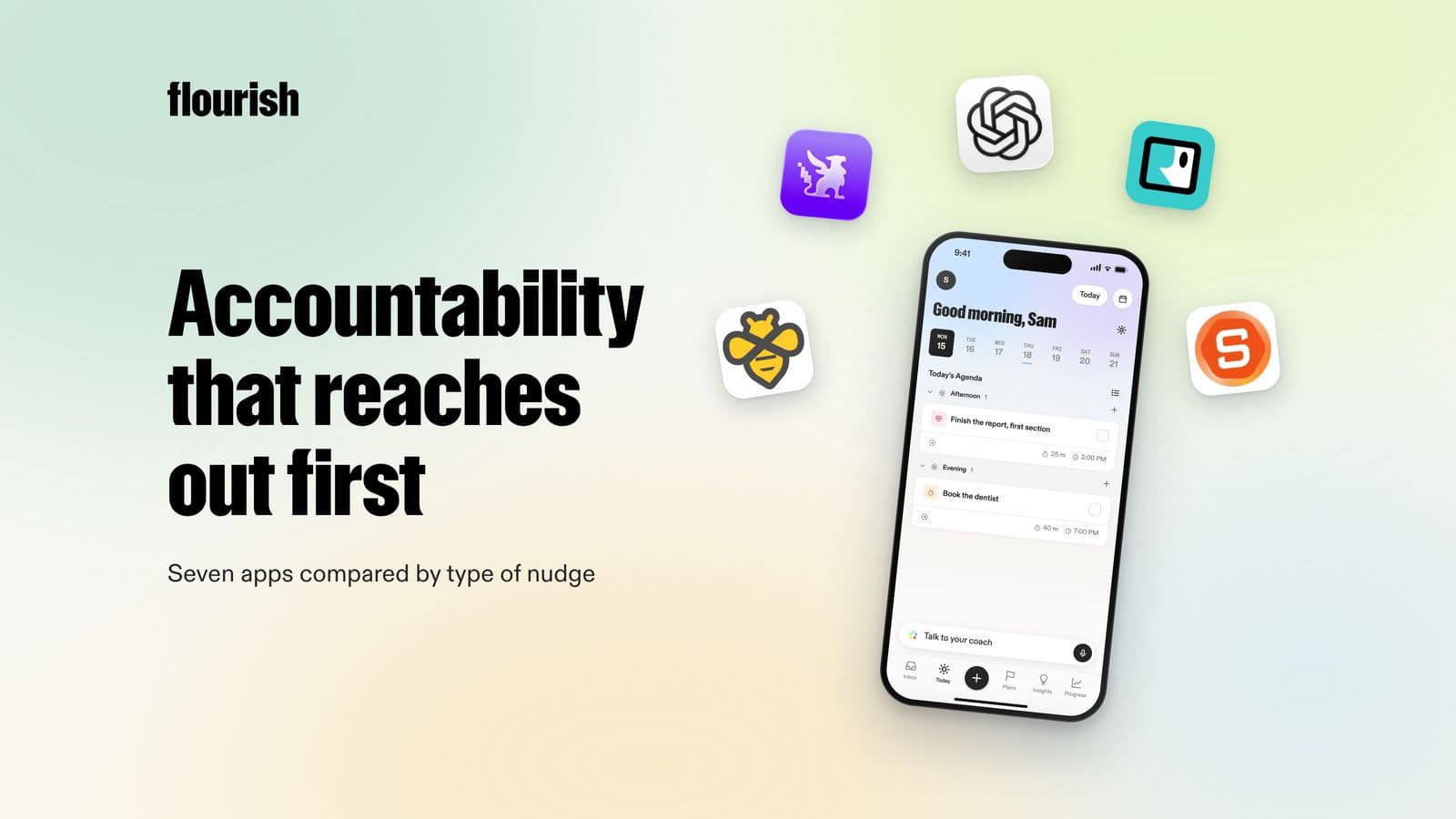
Seven accountability apps compared by the kind of accountability they give you: AI check-ins, body doubling, stakes or a team. Plus why an app that reaches out first beats one you have to remember to open.
By Julian · · 13 min read
The short version
The best accountability app is one that comes to you, because the moment you most need a nudge is the moment you are least likely to open an app. For most people, Flourish is our top pick: it is an AI coach that turns a spoken brain dump into one clear to-do for the day, then reaches out first to check in, challenge and support you. Focusmate is the best choice if you work better with a real person on camera, Rocky.ai suits structured self-development, Beeminder is the strongest option if you want something real at stake, and Habitica works if you like games and have friends to play with. ChatGPT and Saner.ai can both check in on a schedule, with some setup.
Most of us do not lack goals. We lack someone, or something, that notices when the goal quietly slips off the radar on a Tuesday afternoon. That is what an accountability partner does, and it is why the search for one has moved from "find a friend who will text me" to "find an app that will".
This guide explains why accountability works, the four kinds you can choose from, and which apps do each one well.
Why does accountability actually work?
Accountability is not magic and it is not about being told off. The research points to a few plain mechanisms, and good apps are built around them.
Checking your progress makes you more likely to reach a goal. A meta-analysis of 138 studies with nearly 20,000 participants found that prompting people to monitor their progress increased goal attainment, and the effect was stronger when progress was physically recorded or reported to someone else (American Psychological Association, 2015). The more often people monitored, the better they did. That is accountability in its simplest form: someone, or something, regularly asks "how is it going?"
Specific plans beat good intentions. A meta-analysis of 94 tests found that if-then plans, known as implementation intentions, had a medium to large effect on reaching goals (Gollwitzer and Sheeran, 2006). "I will send the invoice straight after the school run" happens far more often than "sort invoices this week". An accountability partner who asks "when, exactly?" is doing this for you.
Commitment devices help some people, but not all. In a randomised trial in the Philippines, smokers offered a contract where they deposited their own savings, and only got them back if they had quit, were more likely to pass a nicotine test at six and twelve months than those who were not offered one (Giné, Karlan and Zinman, 2010). The same study found most people who signed still did not quit, so stakes are a boost, not a guarantee.
Put simply: regular check-ins, specific plans and a reason to follow through. The best accountability apps give you at least one of these without making you do extra work to get it.
Why an app that reaches out first wins
Here is the uncomfortable truth about most productivity apps: they only work on the days you remember to open them. Those are your good days. On the bad days, when the plan has drifted and you feel a bit guilty about it, the app sits silently in a folder on your phone.
That is backwards. A human accountability partner texts you. They do not wait for you to report in. For anyone whose day gets swallowed by other people's needs, and for many ADHD brains where "out of sight, out of mind" is a real pattern, an app that waits to be opened has already lost.
So the first question to ask of any accountability app is simple: does it start the conversation, or do you? It is the same test we used for the best AI life coach apps, and it separates a coach from a tool very quickly.
The four kinds of accountability
Not all accountability feels the same, and the right type depends on what motivates you.
- AI check-ins: an app that asks how things are going, helps you replan and keeps the thread between days. Low effort, always available, no one to let down but yourself.
- Body doubling: working alongside another person, live, so starting feels easier. Real human presence, but you need to book and show up.
- Stakes: a commitment contract where missing your goal costs you something. Powerful for measurable goals, stressful for some people.
- Social and gamified: a team or game where your progress, or lack of it, affects others. Fun if you have the right group.

Many people combine two: an AI coach for the daily loop, plus body doubling for the hardest task of the week.
Ranked: the best accountability apps in 2026
1. Flourish: best AI accountability partner for everyday life

Flourish is an AI coaching app built for people with a head full of loose ends. You talk to it like you would talk to a friend and ramble everything that is on your mind. It sorts that ramble into tasks, prioritises them, and gives you one clear to-do for the day. That to-do also shows on your phone's lock screen, so the most important thing is in front of you every time you pick up your phone.
The accountability comes from the coach. Flourish reaches out proactively to help you plan, to challenge what you are about to do next, and to give insight, accountability and support when a day or week goes off track. You do not have to remember to check in. It checks in with you. It can also connect your calendar, wearables and Gmail inbox, so the plan fits the day you actually have.
- Best for: busy people, parents and many adults with ADHD who need a nudge from something that knows their plan.
- Type of accountability: AI check-ins.
- Platforms: iOS and Android.
- Honest limitation: it is a coach, not a person on a video call and not an agent. It does not do tasks for you, and it is not a focus timer.
Why it is our top pick: it covers the two things the research says matter most, a specific plan and regular check-ins, and it removes the step where you have to remember to open an app. If you often know what you should do but cannot get started, our guide to ADHD paralysis explains why one clear to-do works better than a long list.
2. Focusmate: best for human body doubling
Focusmate is a virtual coworking service. You book a 25, 50 or 75 minute session, get matched with another member of its community, say hello on video and share what you plan to do, then both get on with it. At the end you check in on how it went. You can favourite partners and book with them again, or cowork with a friend.
- Best for: people who start more easily when someone else is working too.
- Type of accountability: body doubling.
- Platforms: runs in the browser on desktop or mobile, with calendar sync.
- Honest limitation: it helps you start and stay on one task, but it does not help you decide what to work on or follow up between sessions.
3. Rocky.ai: best for structured self-development coaching
Rocky.ai offers a personal AI coach with daily reflection, goal tracking and personal development plans. Its coach remembers you across sessions and follows up on goals, with nudges and check-ins designed to turn commitments into action.
- Best for: people who want guided personal growth, such as mindset and habits, rather than help running a busy day.
- Type of accountability: AI check-ins.
- Platforms: iOS, Android and web.
- Honest limitation: the company's focus has shifted towards building white-label coaching apps for organisations, so the personal app is now one part of a wider business product.
4. Beeminder: best for accountability with real stakes
Beeminder combines goal tracking with a commitment contract. You pick a measurable goal, such as pages written, workouts or time off social media, and your progress is plotted against a Bright Red Line. Cross the line and you derail, which means Beeminder charges the pledge you agreed to. Data can be entered by hand or pulled automatically from connected services such as Fitbit, Strava, Duolingo, Todoist, Garmin and Apple Health, plus Zapier and IFTTT.
- Best for: people motivated by consequences, with goals that are easy to count.
- Type of accountability: stakes.
- Platforms: web, iOS and Android.
- Honest limitation: it only works for goals you can put a number on, and the pressure of a pledge can feel punishing on a hard week. It does not help you plan or prioritise.
If you like the idea of stakes but want something simpler, stickK is another commitment contract platform, where you set a goal, decide what is at stake and can invite supporters to cheer you on.
5. Habitica: best for gamified, social accountability
Habitica turns your habits, recurring Dailies and to-dos into a retro role-playing game. Completing real tasks earns gold, experience and gear for your avatar. The accountability comes from Parties: you team up with friends to fight monsters on quests, and if you leave Dailies unfinished, your whole party can take damage.
- Best for: people who enjoy games and have a few friends willing to play.
- Type of accountability: social and gamified.
- Platforms: web, iOS and Android.
- Honest limitation: it needs a fair amount of setup and maintenance, and the social pressure only works if your party stays active.
6. ChatGPT: best if you are happy to set up your own check-ins
ChatGPT is not an accountability app, but its scheduled tasks let it message you at a set time, for example a morning prompt to plan the day or an evening check-in on what got done. Tasks can send a push notification on mobile or an email, and in June 2026 OpenAI added a Scheduled page to manage them. At the same time it retired Pulse, its proactive daily briefing.
- Best for: confident self-starters who want a flexible thinking partner and are happy to write their own prompts.
- Type of accountability: AI check-ins, on a schedule you set.
- Platforms: web and mobile apps.
- Honest limitation: a scheduled task fires whether or not your day has gone to plan, and there is a cap on how many can run at once. It does not hold a live picture of your goals. Our guide on how to use ChatGPT to plan your day has prompts that help.
7. Saner.ai: best if your to-dos live in email and notes
Saner.ai is an AI assistant built for people with ADHD that pulls together notes, email, calendar and documents. It says it proactively plans your day and checks in, and surfaces things to follow up on without you setting manual reminders.
- Best for: knowledge workers whose loose ends are mostly digital.
- Type of accountability: AI check-ins tied to your accounts.
- Platforms: web app and Chrome extension.
- Honest limitation: it is a productivity assistant first, built around connected accounts, and it describes itself as being in beta. If your mental load is family logistics and life admin rather than inbox clutter, a coach may fit better.
Side by side
- Flourish: type: AI check-ins. Reaches out first: yes, a proactive coach. Helps you plan: yes, one clear to-do on your lock screen.
- Focusmate: type: body doubling. Reaches out first: no, you book sessions. Helps you plan: no.
- Rocky.ai: type: AI check-ins. Reaches out first: yes, nudges and check-ins. Helps you plan: partly, through goals and development plans.
- Beeminder: type: stakes. Reaches out first: it asks for your data. Helps you plan: no.
- Habitica: type: social and gamified. Reaches out first: through your party. Helps you plan: you build the lists.
- ChatGPT: type: AI check-ins. Reaches out first: only via tasks you schedule. Helps you plan: yes, when asked.
- Saner.ai: type: AI check-ins. Reaches out first: yes, from connected accounts. Helps you plan: from email and notes.

Is an AI accountability partner as good as a human one?
For daily follow-through, often yes. For deep personal change, not on its own.
A human partner brings something an app cannot: a real relationship, and the feeling that you would rather not let them down. But human partners are also busy. They forget to text, go on holiday or drift away after a few weeks. An AI coach is there at 7am on a Monday and at 4pm on a Thursday when the plan has fallen apart.
There is reasonable evidence that structured AI coaching can help. In two randomised trials with UK students, an AI chatbot coach improved goal attainment about as much as human coaches did (Terblanche et al., PLOS ONE, 2022). Progress was self-reported and the group was narrow, but it supports the idea that regular, goal-focused check-ins matter more than who is doing them.
If you are weighing a specialist coach against an app, our comparison of an ADHD coach vs an AI coach goes through when each makes sense. Plenty of people use both: a human for the big questions, an AI for the daily nudge.
How to choose an accountability app you will keep using
- Start with what motivates you. If guilt and pressure work, try stakes. If company works, try body doubling. If you just need reminding and a bit of support, an AI coach is the lightest touch.
- Check who starts the conversation. Reminders you set yourself are useful, but check-ins that respond to your actual plan are closer to real accountability.
- Make the plan specific. Whatever app you use, turn "this week" into "when and where". That is the implementation intention effect working for you.
- Plan for the bad week. The best partner makes restarting easy. Avoid systems that punish a missed day so hard you quietly give up.
- Keep it to two tools at most. One for the daily loop, one for a specific job like focus. More than that becomes its own chore. For more options, see our list of the best ADHD apps for adults.
The verdict
The best accountability partner is the one that shows up when you do not. Flourish is our pick for most people, because it turns a spoken brain dump into one clear thing to do today and then reaches out first to keep it on track. Focusmate is the best choice if you need a real person working alongside you, Beeminder if you want stakes on a measurable goal, and Habitica if you and your friends like a game.
Frequently asked questions
What is the best AI accountability partner app?
For most people, the best AI accountability partner is one that remembers your plan and reaches out first. Flourish does this: you talk through what is on your mind, it gives you one clear to-do for the day, and its coach checks in to help you plan, challenge your next step and support you when things slip. Rocky.ai is a good alternative for structured self-development.
Can an app really replace an accountability partner?
For daily check-ins, an app can do much of the job and is more reliable than a busy friend, because it is always available and never forgets to message. What it cannot replace is the feeling of not wanting to let a real person down. If that matters to you, pair an AI coach with live body doubling or a friend.
What is body doubling?
Body doubling means working alongside another person, in the same room or on a video call, so it feels easier to start and keep going. You usually each say what you plan to do, then work quietly. Many people find it helps with tasks they have been avoiding. Focusmate is the best-known app built around it.
Do commitment contracts with money actually work?
They can help. In a randomised trial, smokers offered a contract that put their own savings at risk were more likely to have quit months later than those who were not. But most people in that study still did not succeed, so stakes work best for measurable goals and for people who find pressure motivating rather than stressful.
Can ChatGPT be an accountability partner?
Partly. ChatGPT can send you scheduled messages, such as a morning planning prompt or an evening check-in, if you set them up yourself. It is a strong thinking partner, but scheduled tasks fire at fixed times whatever has happened, and it does not track your goals the way a dedicated coaching app does.
Is an accountability app good for ADHD?
Many adults with ADHD find external structure useful, especially reminders that arrive without needing to remember to look for them. An app that checks in first, keeps the plan small and makes restarting easy tends to suit ADHD brains better than one that relies on daily discipline. It is support, not a treatment.
This article is for general information and is not medical advice.
Keep reading

Julian
Flourishing Writer