ADHD Paralysis: What It Is and 9 Ways to Get Unstuck When Everything Feels Urgent
ADHD paralysis is the frozen, stuck feeling of having too much to do and being unable to start any of it. Here is what causes it, nine practical ways to get moving, and the tools that help.
By Julian · · 8 min read
The short version
ADHD paralysis is the stuck, frozen state of knowing you have lots to do and being unable to start any of it. It is not a medical diagnosis or laziness, but a common experience linked to how ADHD affects planning, prioritising and starting. The fastest way out is usually to shrink the problem: get everything out of your head with a two-minute brain dump, pick one thing, make the first step tiny, and attach it to a specific moment. Body doubling, timers, movement and lowering the bar help too. Tools such as Flourish, which turns a spoken brain dump into one clear to-do, can do the choosing for you on days when choosing is the problem. If paralysis is frequent and affecting your life, talk to your GP or a clinician.
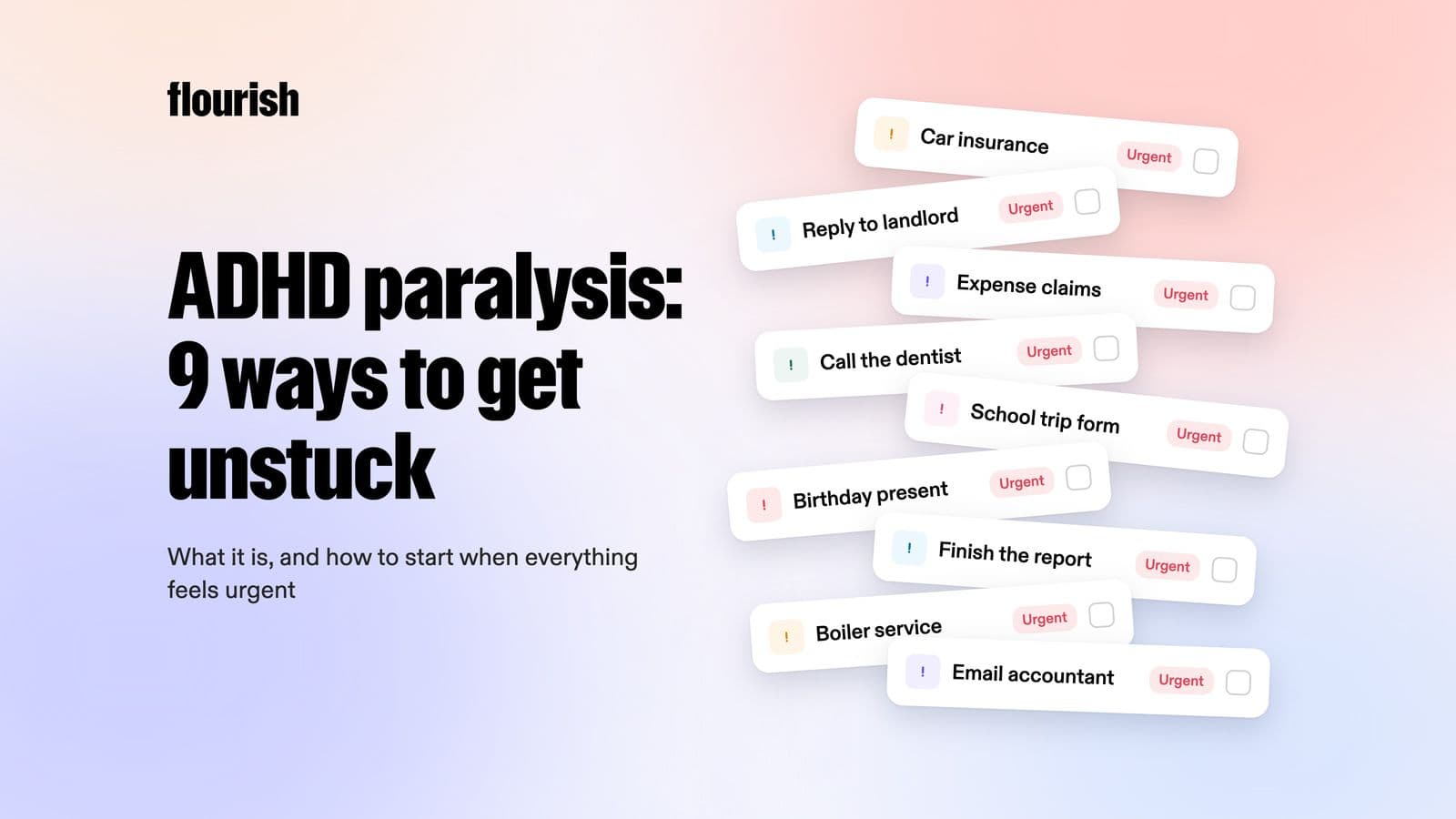
You have a free hour. There are twelve things you need to do. You know roughly what they are. And you end up scrolling, or tidying something that did not need tidying, or just sitting there, because every option feels equally urgent and equally impossible to begin. Then the hour is gone, and with it a bit more confidence.
If that sounds familiar, you are not alone. Searches for "ADHD paralysis" and "task paralysis" run to more than 20,000 a month across the US and UK. The good news is that it responds well to a few specific techniques, most of which work by taking decisions away from a brain that is already overloaded.
What is ADHD paralysis?
ADHD paralysis is an informal term for feeling unable to act, even when you want to and know what needs doing. The Attention Deficit Disorder Association (ADDA) is clear that it is "not a medical diagnosis", but a symptom many people with ADHD recognise (ADDA). It describes three common forms:
- Mental paralysis: so many thoughts and feelings at once that your mind goes blank or static.
- Choice paralysis: too many options, all of which feel important, so you cannot pick one.
- Task paralysis: knowing exactly what the task is, but being unable to start it.
They often stack. A crowded head makes choosing harder, and a task you have avoided for days gets heavier every time you look at it.

Why it happens
ADHD affects the brain's executive functions: the skills we use to plan, prioritise, hold information in mind, manage time and start tasks. When the demands on those skills go up, for example a long to-do list, a vague task or an emotional one, the system can lock up.
A few patterns make it worse:
- Everything feels equally urgent. Without a clear sense of priority, the brain treats twelve tasks as twelve emergencies.
- Tasks are too big or too vague. "Sort finances" is not a task. It is a project with no obvious first move.
- Unfinished tasks keep looping. Research on unfulfilled goals shows they intrude on your thoughts and crowd out other work until you make a concrete plan for them (Masicampo and Baumeister, 2011).
- Shame piles on. Every stuck day adds guilt, and guilt makes the next start harder.
It is worth saying clearly: this is not a willpower problem. The fixes that work tend to lower the cognitive load of starting, rather than asking you to try harder.
9 ways to get unstuck from ADHD paralysis
1. Do a two-minute brain dump
Get everything out of your head, in any order, by voice or on paper. Tasks, worries, errands, half-ideas. The point is to stop your working memory juggling it all. ADDA recommends a daily brain dump as one of its core strategies. Research suggests that simply making a plan for unfinished tasks reduces how much they intrude on your mind, even before you do them.
If typing is a barrier, talk it out. Our guide to the best brain dump apps compares voice options.
2. Pick one thing, or let something pick for you
The dump will be long. Do not try to plan all of it. Ask one question: "If I only do one thing today, which one makes tomorrow easier?" Everything else is parked, not abandoned.
On bad days, even that question is too much. That is a good moment to outsource the choice. An app like Flourish takes your brain dump, prioritises it and gives you one clear to-do for the day, shown on your lock screen, so the decision is already made when you look at your phone.
3. Shrink the first step until it feels almost silly
"Write the report" does not get started. "Open the document and type the title" does. Break the task down until the first step takes under two minutes and requires no decisions. Breaking large tasks into manageable steps is one of the skills taught in CBT for adult ADHD, which in a JAMA trial doubled the rate of meaningful symptom improvement compared with relaxation training (Safren et al., 2010).
Free tools like Goblin Tools' Magic ToDo will break a task into steps for you if you cannot see where to begin.
4. Attach it to a when and where
Turn your one thing into an if-then plan: "When I sit down after lunch, I will open the council tax email." Specific if-then plans, called implementation intentions, have a medium-to-large effect on following through in studies. In one experiment, children with ADHD who used if-then plans performed as well as children without ADHD on a task measuring impulse control (Gawrilow and Gollwitzer, 2008).
5. Borrow someone else's presence (body doubling)
Many people with ADHD find it easier to start when someone else is nearby and working, whether in person, on a video call or on a service like Focusmate. ADDA notes there is no formal research proving body doubling works yet, but it is widely reported as helpful and costs little to try.
6. Use a timer to make it finite
"Work on it for ten minutes" is far less daunting than "do it". Set a short timer and give yourself permission to stop when it ends. Often you will keep going. Timer apps such as Llama Life or Forest, or just your phone's clock, make time visible.
7. Move your body first
A short walk, a few star jumps or even standing up and changing rooms can break the freeze. ADDA lists movement among its strategies. Physical activity is also a well-established way to lift mood and energy, which makes starting easier.
8. Lower the bar on purpose
Perfectionism often hides inside paralysis: if it cannot be done properly, it does not get started. Decide in advance that the goal is "done badly" or "a first rough version". You can always improve something that exists.
9. Build in accountability and a reward
Tell someone what you will do and when, or use a tool that checks in with you. External accountability replaces the internal pressure that ADHD brains often find hard to generate on demand. Pair it with a small, immediate reward for starting, not just for finishing.

A 10-minute reset for when you are stuck right now
- Minute 0 to 2: Brain dump everything, out loud or on paper.
- Minute 2 to 3: Circle one thing that would make tomorrow easier.
- Minute 3 to 4: Write its first two-minute step.
- Minute 4 to 5: Decide exactly when and where you will do that step. Ideally, now.
- Minute 5 to 10: Set a five-minute timer and do only that step.
If you get to minute ten and you want to stop, stop. You have broken the freeze, and that is the win.
Tools that help with ADHD paralysis

- Flourish: best for when choosing is the problem. Talk through everything on your mind and get it sorted, prioritised and reduced to one clear to-do on your lock screen, with a coach that checks in.
- Goblin Tools: best for breaking a task into tiny steps.
- Focusmate: best for body doubling.
- Llama Life: best for working through one task at a time with a timer.
- Tiimo: best for seeing your day visually, with a built-in focus timer.
For the full comparison, see the best ADHD apps for adults in 2026.
When to get professional help
Occasional stuck days happen to everyone. If paralysis is frequent, lasts for long periods, or is affecting your work, relationships or health, it is worth speaking to your GP or a qualified clinician. That is especially true if you have not been assessed for ADHD, or if low mood or anxiety is part of the picture. Assessment can open up treatment options, including medication, therapy and coaching, which work well alongside the strategies above.
The verdict
ADHD paralysis eases when you reduce the number of decisions standing between you and the first action. Dump everything, choose one thing, make the first step tiny, and give it a time. On the days when even choosing one thing feels impossible, let a tool do the choosing. That is exactly what Flourish is built for: you talk, it turns the noise into one clear to-do, and it checks in so you do not have to rely on willpower alone.
Frequently asked questions
What is ADHD paralysis?
ADHD paralysis is an informal term for feeling unable to start tasks or make decisions, even when you want to. ADDA describes three types: mental paralysis (overwhelm from too many thoughts), choice paralysis (too many options) and task paralysis (unable to start a specific task). It is not a medical diagnosis.
How do I get out of ADHD paralysis quickly?
Do a two-minute brain dump, choose one thing that would make tomorrow easier, break its first step down to under two minutes, and decide exactly when you will do it. Then set a five-minute timer and start. Moving your body or working alongside someone else can also help.
What is the difference between ADHD paralysis and procrastination?
Procrastination usually means putting a task off in favour of something more pleasant. ADHD paralysis feels more like being frozen: you want to act and may be distressed that you cannot. In practice they overlap, and the same techniques, such as making tasks smaller and more specific, help with both.
Is task paralysis a sign of ADHD?
Task paralysis is common in ADHD, but it can also happen with stress, burnout, anxiety or depression. On its own it is not enough to suggest ADHD. If it is frequent and affecting your life, speak to a GP or clinician about assessment.
What apps help with ADHD paralysis?
Apps that reduce decisions help most. Flourish turns a spoken brain dump into one clear to-do and checks in on you. Goblin Tools breaks tasks into steps for free. Focusmate offers body-doubling sessions, and Llama Life and Forest use timers to make work feel finite.
Why does a long to-do list make ADHD paralysis worse?
A long list presents many equally weighted options at once, which increases choice paralysis. Narrowing the list to one clear priority for the day removes the need to choose in the moment, which is often the hardest part.
This article is for general information and is not medical advice.
Keep reading

Julian
Flourishing Writer