The Best Tiimo Alternatives in 2026
Seven Tiimo alternatives, grouped by why you are leaving: you want less planning, a timeline elsewhere, routines, one task at a time or help breaking tasks down. With platforms and honest limits.
By Julian · · 10 min read
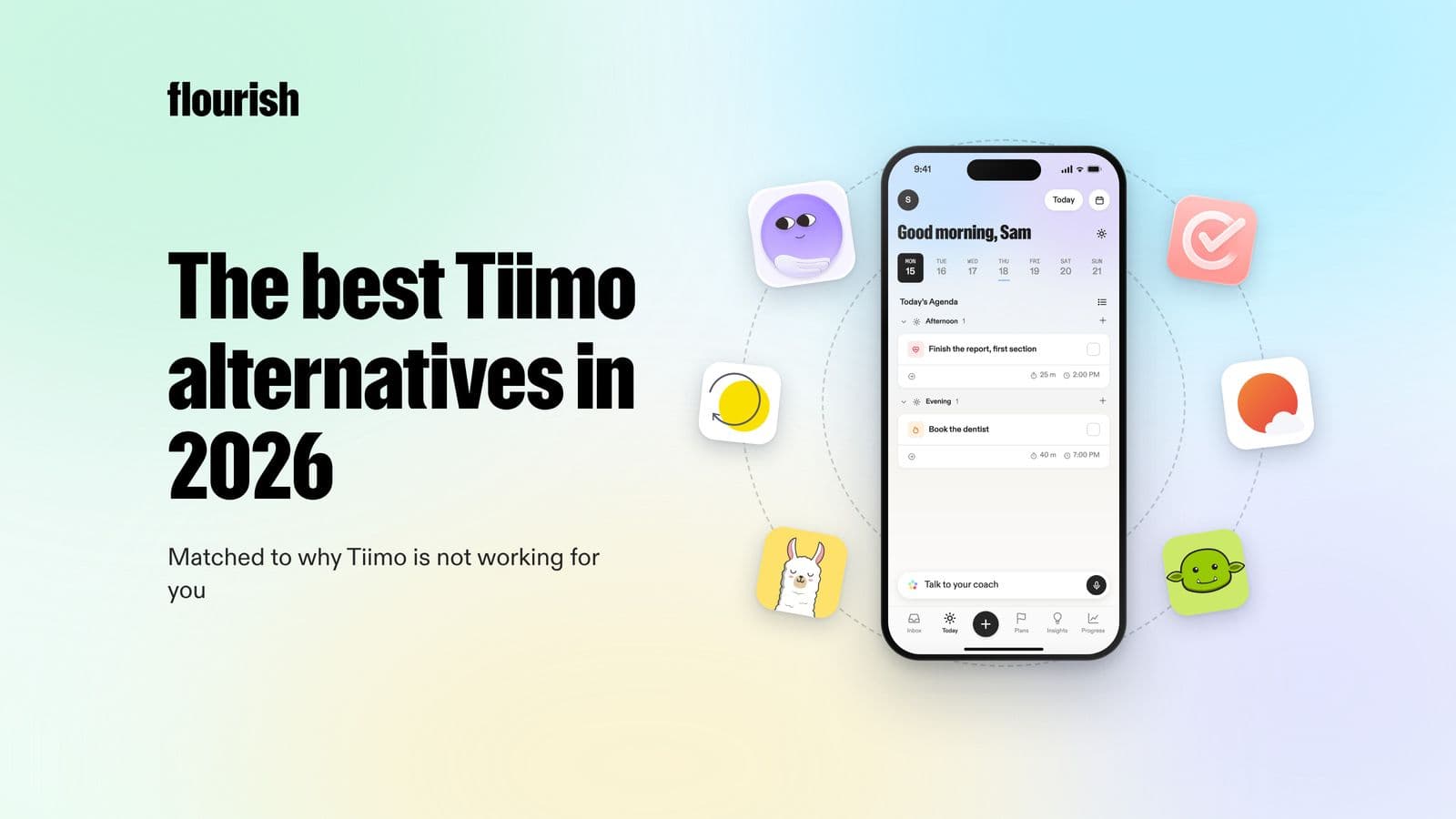
The short version
The best Tiimo alternative depends on why Tiimo stopped working for you. If a visual timeline means you still have to plan every block yourself, Flourish is our top pick: you talk through everything on your mind, it sorts and prioritises it, and you get one clear to-do on your lock screen plus a coach that checks in. If you love the timeline but want a different one, try Structured. For routines, Routinery. For one task at a time, Llama Life. For breaking a task into steps, Goblin Tools. For a calm work-day planning ritual, Sunsama, and for a solid list, Todoist.
Tiimo is a genuinely good app. It is a visual planner built with ADHD and autism in mind, and it won iPhone App of the Year at the 2025 App Store Awards. So if you are looking for an alternative, it is probably not because Tiimo is bad. It is because the way it works does not match the way your days work. This guide is grouped around that.
Why do people look for a Tiimo alternative?
Tiimo turns your day into a colourful visual schedule, with an AI planner, a to-do list, a focus timer, widgets, mood tracking and Apple Watch support, across iPhone, iPad, Android and the web (Tiimo). That is a lot of support. But a visual planner still rests on one assumption: that you can decide what goes in each block, and that the day will roughly go to plan.
For many people that is exactly where things break. In our experience, these are the five most common reasons people go looking:
- You want less planning. Building the day is the hard part, and a beautiful timeline does not make the decisions for you.
- You want a timeline, just a different one. You like seeing time, but want a simpler or different layout.
- You mainly need routines. Mornings and evenings are where the day falls apart, not the middle.
- You want one task at a time. Seeing a full day of blocks is itself overwhelming.
- You want task breakdown. The problem is not when to do something, but how to start it.

If your days are unpredictable, with children, shifts, clients or energy that changes hour to hour, a carefully built schedule can feel out of date by 10am. That is not a personal failing. It is a mismatch between the tool and your life. Our guide to the best ADHD apps for adults groups tools by the job they do, if you want the wider view.
Ranked: the best Tiimo alternatives in 2026
1. Flourish: best if you want less planning, not a better planner

Flourish is an AI coaching app for people with a million things in their head and no obvious place to start. Instead of asking you to build a schedule, it starts from the mess. You talk, and ramble everything on your mind. Flourish turns that brain dump into tasks, prioritises them, and gives you one clear to-do for the day. That to-do also shows on your phone's lock screen, so the most important thing is the first thing you see.
The second half is the coach. Flourish reaches out proactively to help you plan, to challenge what you are about to do next, and to offer insight, accountability and support. You do not have to remember to open it, which matters when "out of sight, out of mind" is how your week tends to go. It can also connect your calendar, wearables and Gmail inbox, so the plan fits the day you actually have.
- Best for: people leaving Tiimo because planning every block is the exhausting part.
- Platforms: iOS and Android.
- Honest limitation: it is not a visual timeline or a focus timer. If you want to see your whole day laid out hour by hour, pair it with a planner or stay with Tiimo.
Why it is our top pick: when every task feels equally urgent, a timeline just shows you all of them at once. One clear priority and a coach that follows up is a different approach, and for many people it is the one that sticks. If you often freeze in front of a full day, our guide to ADHD paralysis explains why choosing one thing helps.
2. Structured: best if you still want a visual timeline
Structured is the closest like-for-like swap. It lays your day out as a vertical timeline of tasks, lets you create tasks quickly or import your existing calendar, and adds weekly and monthly views, notes, widgets and notifications (Structured). Structured AI can build a schedule from natural language, and it supports recurring tasks for routines (App Store).
- Best for: people who like seeing the shape of the day but want a cleaner, simpler timeline.
- Platforms: iPhone, Android, web and Apple Watch.
- Honest limitation: you still have to decide what goes in each slot, so it will not help much if planning itself is the problem.
3. Routinery: best for routines
Routinery turns a routine into an ordered checklist with a timer for each step, and talks you through it with voice alerts so you know what comes next (App Store). You can pause, skip or add steps mid-routine, build your own routines or start from ready-made ones, and track streaks over time (Routinery).
- Best for: people whose mornings, evenings or transitions are where the day falls apart.
- Platforms: iPhone, iPad, Mac, Apple Watch and Android.
- Honest limitation: it is built for repeating routines, not one-off tasks or deciding what matters today.
4. Llama Life: best for one task at a time
Llama Life is designed to help you focus on one task at a time. Every task gets its own countdown timer, the app shows the total time for your list and an estimated finish time, and finishing a task triggers a small celebration (App Store). You can save preset lists for routines and add chimes or soundscapes to pull you back on track (Todoist integrations).
- Best for: people who find a full visual day overwhelming and work better in short sprints.
- Platforms: iPhone and desktop web.
- Honest limitation: you still choose what goes on the list, and there is no Android app yet.
5. Goblin Tools: best for breaking tasks down
Goblin Tools is a set of small AI tools built for neurodivergent people. Magic ToDo breaks a task into steps, Estimator guesses how long something will take, Compiler turns a typed brain dump into actions, and Judge helps read the tone of a message. The core tools are free on the web, with no ads, and there are iOS and Android apps (Goblin Tools).
- Best for: the moment you are staring at "sort out the spare room" and cannot see step one.
- Platforms: web, iOS and Android.
- Honest limitation: the developer is clear that output is "only guesswork" and accuracy varies. It does not plan your day or follow up. If it is not quite right for you either, see our roundup of Goblin Tools alternatives.
6. Sunsama: best for a calm work-day planning ritual
Sunsama is a daily planner built around a guided ritual. Each morning you pull in tasks from your calendars, task apps and work tools, choose a realistic workload, and timebox it onto your calendar. At the end of the day, a shutdown routine helps you stop on time (Sunsama).
- Best for: people who want structure for their working day and like a deliberate start and finish.
- Platforms: iOS, iPadOS, Android, macOS, Windows and Linux.
- Honest limitation: it is designed around work and work tools, and the morning ritual asks for planning effort every day, which is the very thing some people leave Tiimo to avoid.
7. Todoist: best if you just want a solid list
Todoist is a mature task manager with Today and Upcoming views, recurring tasks, reminders, priorities and labels. Ramble captures tasks from your voice in natural language, and Todoist Assist helps turn scattered tasks into action plans (Todoist).
- Best for: people for whom lists already work, who want fast capture and dependable reminders.
- Platforms: phone, tablet, watch, desktop and web.
- Honest limitation: a list shows you everything, which overwhelms many ADHD brains. It will not decide what matters today or check in on you.
Side by side
- Flourish: why switch: less planning. Shows: one clear to-do. Follows up: yes, a proactive coach.
- Structured: why switch: a different timeline. Shows: the whole day. Follows up: notifications.
- Routinery: why switch: routines. Shows: one routine step at a time. Follows up: voice alerts during a routine.
- Llama Life: why switch: one task at a time. Shows: the current task and its timer. Follows up: chimes during a task.
- Goblin Tools: why switch: task breakdown. Shows: the steps for one task. Follows up: no.
- Sunsama: why switch: a work-day ritual. Shows: today's timeboxed workload. Follows up: daily planning and shutdown prompts.
- Todoist: why switch: a plain list. Shows: everything due. Follows up: reminders.

Which Tiimo alternative fits why you are leaving?
- "Planning every block wears me out." Try Flourish. You talk, it chooses one priority, and the coach follows up so you do not have to rebuild the day each time it changes.
- "I like the timeline, just not this one." Try Structured. It is the most direct swap.
- "My mornings are the problem." Try Routinery, and keep any planner you like for the rest of the day.
- "Seeing the whole day makes me freeze." Try Llama Life, or Flourish if you also want help choosing what goes first.
- "I know when, I just cannot start." Try Goblin Tools for steps, then come back to your plan.
- "I need structure for work." Try Sunsama.
Two apps is usually the sensible maximum: one to decide what matters and one to help you do it. Our ADHD planner apps guide covers more planning-first options if you want to compare further.
When is Tiimo still the right choice?
It is worth being honest: for some people, the right move is to stay. Tiimo is still the best fit if:
- You think visually and seeing time pass genuinely calms you.
- Your days are fairly predictable, so a planned schedule holds up.
- You want planning, a focus timer, mood tracking and Apple Watch support in one app, rather than stitching tools together.
- You are autistic or have ADHD and value a tool designed with those experiences in mind from the start.
If Tiimo mostly works but planning is the sticking point, you do not have to choose. Some people use Flourish to decide the one thing that matters today, then use Tiimo or Structured to place it in the day.
The verdict
The best Tiimo alternative is the one that fixes the reason you are leaving. If building the day is the hard part, or your days rarely go to plan, Flourish is our pick, because it turns a spoken brain dump into one clear priority and then checks in so it happens. Structured is the best like-for-like visual timeline, Routinery is best for routines, Llama Life is best for one task at a time, and Goblin Tools is the simplest way to break a daunting task into steps.
Frequently asked questions
What is the best alternative to Tiimo?
It depends on why Tiimo is not working. If planning every block is the problem, Flourish is a strong choice because it turns a voice brain dump into one clear to-do and has a coach that checks in. If you want another visual timeline, Structured is the closest swap. Routinery suits routines, and Llama Life suits people who prefer one task at a time.
Is Structured better than Tiimo for ADHD?
Neither is better for everyone. Both are visual planners. Tiimo is designed specifically with neurodivergent people in mind and bundles in a focus timer, mood tracking and Apple Watch support. Structured is a cleaner, simpler timeline that many people find easier to keep up. If you want more built-in support, choose Tiimo; if you want a simple timeline, try Structured.
Why do people stop using Tiimo?
The most common reason is that a visual schedule still needs you to plan it. On busy or unpredictable days, the plan can go out of date quickly, and rebuilding it takes energy. Others find a full day of blocks overwhelming, or realise their real problem is starting tasks or getting through routines, which other apps handle more directly.
Is there a Tiimo alternative that plans for you?
Flourish is built for this. Instead of asking you to fill in a timeline, it takes a spoken ramble of everything on your mind, sorts it into tasks, prioritises them and gives you one clear to-do for the day. Its coach then reaches out proactively to help you plan, stay accountable and adjust when the day changes.
Is there a free Tiimo alternative?
Goblin Tools is free on the web with no ads, and is useful for breaking tasks into steps, estimating time and turning a typed brain dump into actions. It does not plan your day or follow up, so many people pair it with a planner or a coaching app that helps decide what matters most today.
This article is for general information and is not medical advice.
Keep reading

Julian
Flourishing Writer