Best AI Life Coach Apps in 2026 (and Whether ChatGPT Can Replace One)
We compared seven AI life coach apps on what actually matters day to day: does it remember you, does it check in first, and does it turn talk into a plan. Plus an honest answer on whether ChatGPT can do the job.
By Julian · · 13 min read
The short version
The best AI life coach app in 2026 is the one that does three things a chatbot on its own does not: it remembers your context, it reaches out to you first, and it turns what you say into a concrete plan for today. Flourish does all three from a voice brain dump, which is why it tops this list. Rocky.ai is the strongest pick for structured soft-skills coaching, ChatGPT is the most flexible if you are happy to drive every conversation yourself, and TaskCoach, Mindsera, Lifestack and Saner.ai each suit a narrower need. Human coaching still averages $234 a session worldwide, so an AI coach is best treated as daily follow-through, not a replacement for deep one-to-one work.
A life coach used to mean a weekly call and a notebook of good intentions. The call was useful. The six days in between were where things fell apart: the plan you made on Monday met a sick child on Tuesday, a deadline on Wednesday and a brain that simply had too much in it by Thursday.
That gap is what AI coaching apps are trying to close. Some are journals with a chatbot attached. Some are planners that talk. A few are genuine coaches that know your goals, notice when things slip and help you decide what to do next. This guide separates them, and answers the question most people ask first: can't ChatGPT just do this?

What we compared, and why
Most "best AI coach" lists compare features. That is the wrong lens, because nearly every app now has a chat box, goals and reminders. What separates a coach from a chatbot is behaviour, so we scored each app on three questions:
- Does it remember you? A coach that forgets last week's conversation is a stranger every time. We looked for persistent context about your goals, constraints and patterns.
- Does it reach out first? Human coaches follow up. Most AI tools wait for you to open them, which is exactly when you are least likely to.
- Does it turn talk into a plan? Insight is nice. A short list of what to do today is what changes the week.
We also noted what each app does not do. That matters as much as the feature list, because the wrong kind of coach is worse than none.
Ranked: the best AI life coach apps in 2026
1. Flourish: best for turning a full head into a plan for today

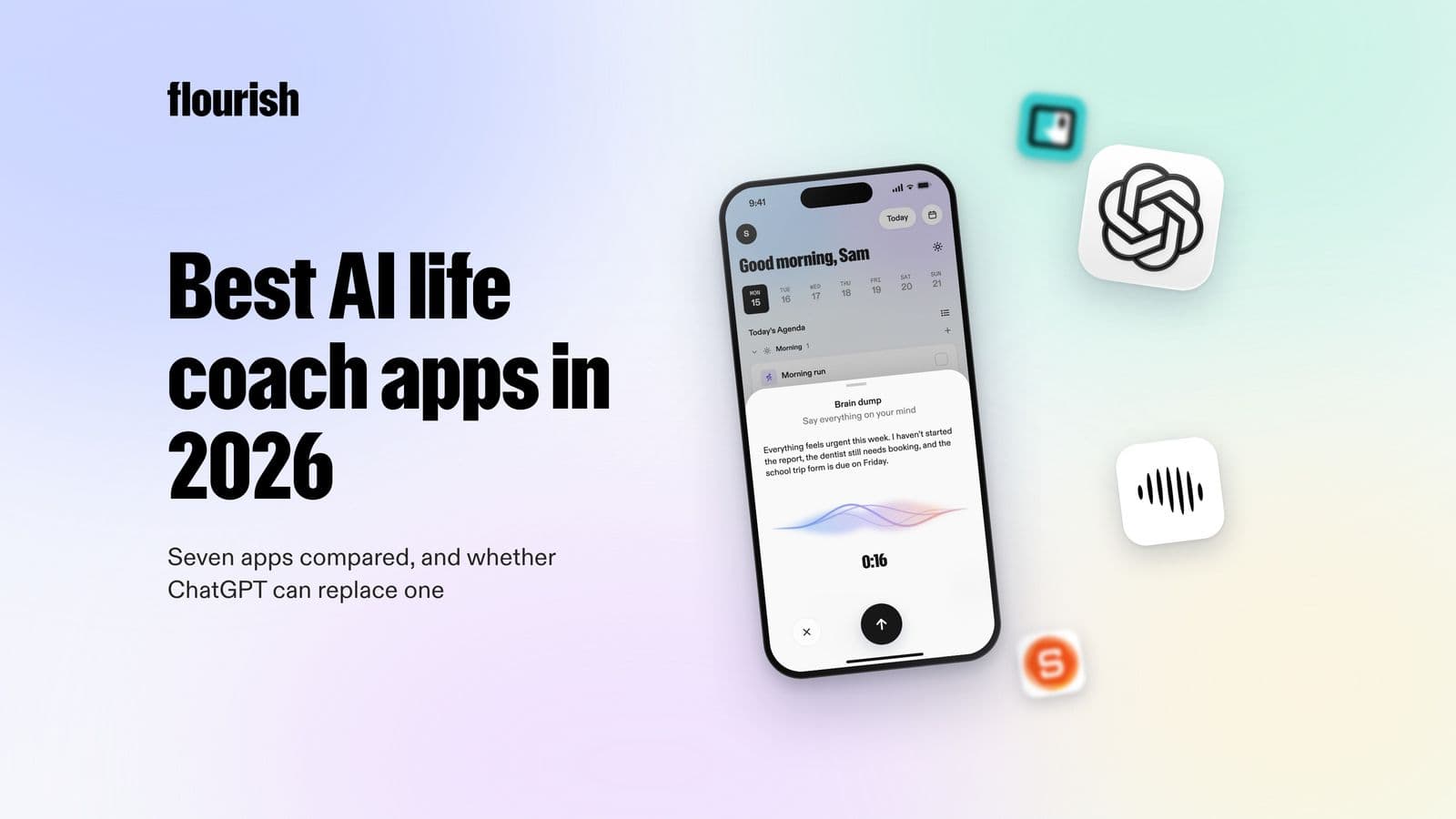
Flourish is a personal coach app built around one habit: talk to it the way you would talk to a friend, dump everything that is on your mind, and it comes back as a plan for your day. Under the hood, the voice brain dump is sorted into tasks, those tasks are prioritised, and you get one clear to-do for the day, which also sits on your phone's lock screen so it is the first thing you see.
The coaching part is proactive. Flourish reaches out to help you plan, to challenge what you are about to spend your time on, and to give insight, accountability and support when a week goes sideways. It can also connect to your calendar, wearables and Gmail inbox so the plan fits around real time and real energy, not an idealised version of your week.
- Remembers you: yes, it builds context from your conversations and plan over time.
- Reaches out first: yes, proactive check-ins are a core feature.
- Turns talk into a plan: yes, voice dump to sorted, prioritised tasks and one daily focus.
- What it does not do: it does not act on your behalf. It is a coach, not an agent.
Best for: people carrying a heavy mental load, including many adults with ADHD, who know what they want from life but lose the thread in the day to day. If your problem is "I have a million things in my head and no obvious place to start", this is the one to try first. Our guide to the best brain dump apps goes deeper on the capture side.
2. Rocky.ai: best for structured soft-skills coaching
Rocky.ai is one of the longest-running AI coaching apps and focuses on personal development topics such as mindset, discipline and confidence. It runs daily check-ins and reflections, sets reminders and follows up on goals, and it remembers context across sessions.
- Remembers you: yes, it keeps context between sessions.
- Reaches out first: yes, through daily check-ins and reminders.
- Turns talk into a plan: partly. It is stronger on reflection and skill-building than on planning a specific day.
- What to know: the company increasingly sells a white-label coaching platform to businesses, and the free tier is narrow.
Best for: people who want a guided self-improvement curriculum rather than help running their day.
3. ChatGPT: best general-purpose option, if you drive it
ChatGPT is not a coaching app, but it is the tool most people try first, and for good reason. It is excellent at thinking out loud with you, reframing a problem, drafting a plan or role-playing a hard conversation. With memory switched on it can recall facts about you across chats, and scheduled tasks let it send you a reminder or a daily prompt.
- Remembers you: partly. Memory recalls saved facts and past chats, but it is not built around a model of your goals and week.
- Reaches out first: only through scheduled tasks you set up yourself. Plus allows 5 active tasks at a time. OpenAI retired Pulse, its proactive morning briefing, in June 2026.
- Turns talk into a plan: yes, if you ask well every time. See our guide to planning your day with ChatGPT for prompts that work.
- What to know: there is no coaching framework, no goal tracking and no daily plan that persists. You start every session.
Best for: confident self-starters who want a brilliant thinking partner and do not need to be chased.
4. TaskCoach: best for ADHD "life OS" fans who like lots of modules
TaskCoach describes itself as an AI life operating system for ADHD brains, covering goals, habits, tasks, journaling and focus in one place. Its Plan Day feature offers three versions of your schedule (Recover, Steady and Push) depending on how much you have in the tank.
- Remembers you: yes, within its goal and habit system.
- Reaches out first: some features, with limits on the free plan.
- Turns talk into a plan: yes, via Plan Day.
- What to know: its conversational "Brain Chat" is Premium, and some AI features have usage caps. Breadth can mean more set-up.
Best for: people who want one app to replace a planner, habit tracker and journal, and enjoy configuring it.
5. Mindsera: best for reflective journaling with an AI mentor
Mindsera is an AI journal rather than a planner. It analyses the emotions in your entries, offers personality insights and gives you more than 50 thinking frameworks to work through decisions. It supports voice and handwritten pages, and entries are end-to-end encrypted.
- Remembers you: yes, across your journal history.
- Reaches out first: light prompts, but it is designed for when you choose to reflect.
- Turns talk into a plan: not really. Its strength is clarity and self-understanding.
- What to know: the AI coaching features sit behind the paid plan, and new users report a learning curve.
Best for: people who process life by writing and want deeper reflection, not a to-do list.
6. Lifestack: best for energy-based scheduling with wearables
Lifestack plans your day around your energy. It pulls sleep and recovery data from wearables and places tasks into "Energy Zones", so demanding work lands when you are most able to do it.
- Remembers you: yes, through your data and calendar.
- Reaches out first: schedule-driven nudges rather than coaching conversations.
- Turns talk into a plan: it turns your calendar and tasks into a schedule. It is less about talking things through.
- What to know: it assumes you already know what your tasks are. It is a scheduler with coaching flavour, not a coach.
Best for: data-minded people with a wearable who want their calendar to respect their energy.
7. Saner.ai: best if your overwhelm lives in email and documents
Saner.ai is an AI assistant that pulls together your email, calendar, notes and documents and suggests what to prioritise. If your mental load is mostly digital clutter, that connected view is its strength.
- Remembers you: yes, via your connected accounts and notes.
- Reaches out first: suggestions and summaries rather than coaching check-ins.
- Turns talk into a plan: it turns your inbox and notes into priorities.
- What to know: it is a productivity assistant first. If your overwhelm is life admin, family logistics or a head full of loose ends, a coach may fit better.
Best for: knowledge workers whose to-dos are buried in their inbox.
Side by side
- Flourish: remembers you: yes. Checks in first: yes. Daily plan from talk: yes, one clear to-do on your lock screen.
- Rocky.ai: remembers you: yes. Checks in first: yes. Daily plan from talk: partly.
- ChatGPT: remembers you: partly. Checks in first: only via tasks you schedule (5 on Plus). Daily plan from talk: yes, on request.
- TaskCoach: remembers you: yes. Checks in first: limited. Daily plan from talk: yes.
- Mindsera: remembers you: yes. Checks in first: light. Daily plan from talk: no.
- Lifestack: remembers you: via data. Checks in first: schedule nudges. Daily plan from talk: from your calendar.
- Saner.ai: remembers you: via connected accounts. Checks in first: suggestions. Daily plan from talk: from inbox and notes.
Can ChatGPT replace a life coach?
For thinking, often yes. For follow-through, usually not, and the reason is structural rather than a question of intelligence.
A coach's value comes from three things: context, continuity and accountability. ChatGPT is strong on the first when you give it enough detail, and memory helps. It is weak on the other two. It does not hold a live picture of your week, it does not notice that the thing you promised to do on Monday still is not done on Thursday, and since Pulse was retired it will not start a conversation unless you have set up a scheduled task in advance. On the Plus plan you can have five of those running at once.
That is fine if you are the kind of person who opens a chat every morning and plans your day. Most people who look for a coach are looking precisely because they are not. The whole point is that something else holds the thread when your head is full.
The research backs the idea that AI coaching can work when it is structured. In two ten-month randomised trials with 327 UK students, an AI chatbot coach improved goal attainment about as much as human coaches did (Terblanche et al., PLOS ONE, 2022). The participants were students and progress was self-reported, so it is not the final word, but it points the same way as the wider evidence: what helps is regular goal-focused check-ins, not a clever answer once.
A practical way to use both: think with ChatGPT when you need a sounding board, and let a coach app own the daily loop of planning, nudging and adjusting.
AI life coach vs human life coach
This is not either-or. The 2025 ICF Global Coaching Study puts the average fee for a one-hour session at $234 worldwide (ICF, 2025). That buys deep, human attention for an hour. It does not buy help at 7:40 on a Tuesday morning when you are staring at twenty things and cannot pick one.
- A human coach is better for: career transitions, confidence and identity work, complex relationships, and anything where being truly understood by another person is the point.
- An AI coach is better for: the daily layer. Turning a messy week into a plan, deciding what matters today, noticing drift early and restarting without guilt after a bad day.
- Neither replaces clinical care. If low mood, anxiety or suspected ADHD is getting in the way of daily life, speak to your GP or a qualified clinician. A 2023 meta-analysis of 15 trials found AI chatbots reduced depressive symptoms and distress, but had no significant effect on overall wellbeing (Li et al., npj Digital Medicine, 2023). Useful support, not treatment.
Many people will get the most from a human coach monthly and an AI coach daily.
How to choose an AI life coach app
- Start with where you get stuck. If you lose the plot between intention and action, pick a coach that checks in first. If you need to understand yourself better, a journal like Mindsera may suit you. If your problem is a crowded calendar, a scheduler like Lifestack fits.
- Test the memory in week two, not day one. Every app feels smart on day one. The question is whether it still knows your priorities after a messy week.
- Check what "proactive" really means. A reminder you set yourself is not coaching. Look for check-ins that respond to what is actually happening in your week.
- Keep the output small. A coach that hands you a 25-item list has not helped. One to three priorities a day is the target. That is why Flourish surfaces a single clear to-do.
- Know what data it touches. Some apps read your inbox or health data. Decide what you are comfortable with before you connect accounts.
Why a plan beats a pep talk
The reason daily planning matters so much is well studied. A meta-analysis of 94 tests found that forming specific if-then plans, known as implementation intentions, had a medium-to-large effect on reaching goals (Gollwitzer and Sheeran, 2006). In plain terms: "I will call the dentist after I drop the kids off" gets done far more often than "sort the dentist this week".
The best AI coaches build that into the product. They do not just motivate you. They help you decide what, when and what happens if the day goes off script.
The verdict
If you want an AI life coach that behaves like a coach, not a chatbot, choose one that remembers you, reaches out first and ends each conversation with a plan. Flourish is our pick for most people with a busy head and a full life, because it turns a spoken brain dump into one clear thing to do today and follows up when the week slips. Rocky.ai is the better fit for a structured self-development course, and ChatGPT remains the best free thinking partner if you are disciplined enough to drive it every day.
Frequently asked questions
What is the best AI life coach app?
For most people, the best AI life coach app is one that combines memory, proactive check-ins and daily planning. Flourish does all three: you talk through what is on your mind, it sorts and prioritises it into one clear to-do for the day, and it checks in to keep you on track. Rocky.ai is a strong alternative for structured mindset and discipline coaching.
Can ChatGPT be my life coach?
ChatGPT can be a very good thinking partner, but it is not built to coach you day to day. It only reaches out through scheduled tasks you set up yourself (five at a time on Plus), it has no goal tracking, and OpenAI retired its proactive Pulse briefing in June 2026. It works best alongside a dedicated coach app rather than instead of one.
Are AI life coaches worth it?
They are worth it if your challenge is follow-through rather than insight. An AI coach costs a fraction of a human session, which averages $234 an hour worldwide according to the ICF, and it is available every day. Research suggests structured AI coaching can improve goal attainment, though it does not replace therapy or clinical care.
Is there a free AI life coach app?
Yes. Flourish is free to download, Rocky.ai, TaskCoach and Mindsera have free tiers, and ChatGPT has a free plan. Free tiers usually limit the proactive or conversational features that make coaching useful.
What is the difference between an AI coach and an AI planner?
An AI planner schedules tasks you already have. An AI coach helps you work out what matters, decide what to do today and stay on track when things change. Some apps, including Flourish, combine both by turning a brain dump into a prioritised plan and then checking in on it.
Can an AI life coach help with ADHD?
Many adults with ADHD find external structure helpful, especially for starting tasks and deciding what to do first. An AI coach that captures thoughts quickly, picks one clear next step and checks in can support that. It is not a diagnosis or treatment. See our guide to the best ADHD apps for adults for more options.
Keep reading

Julian
Flourishing Writer