How to Do a Brain Dump: A Step-by-Step Guide for Overwhelmed Minds
A brain dump gets everything out of your head and into one place so you can see it, sort it and choose one thing to do. Here is how to do one in five steps, on paper, by voice or with an app.
By Julian · · 8 min read
The short version
To do a brain dump, set a timer for ten minutes and write or say everything on your mind, without sorting or judging it. Then go back through the list and sort each item: a task, a worry, an idea or something to drop. Pick the one task that matters most today, give it a time, and park the rest somewhere you trust. Repeat it whenever your head feels full. You can do it on paper, in a notes app or out loud: Flourish lets you talk it all out and turns the ramble into a prioritised list with one clear to-do for the day.
A brain dump is the simplest tool there is for overwhelm. It costs nothing, takes ten minutes, and works because a thought written down is a thought you no longer have to hold.
What is a brain dump?
A brain dump is the act of getting everything that is taking up space in your head onto a page, or into an app, in one go. Tasks, worries, half-ideas, things you must not forget, the email you keep meaning to send: all of it, in no particular order.
It is not a to-do list, at least not at first. A to-do list is sorted and selective. A brain dump is deliberately messy, because the goal is to empty your head before you start deciding anything. It is also the first step of most productivity systems: Getting Things Done calls it capture, and our guide to simpler alternatives to GTD explains why that step does most of the work.
Why does a brain dump help?
Unfinished tasks have a way of nagging at you. Psychologists have long described a pull to return to interrupted tasks, and a 2025 meta-analysis found that this tendency to resume unfinished tasks is real and general, even though the old claim that we remember them better did not hold up.
Planning quiets that pull. In a series of experiments, Masicampo and Baumeister found that unfinished goals caused intrusive thoughts and hurt performance on an unrelated task, but making a specific plan for those goals removed the effect. A sleep study found something similar at bedtime: people who spent five minutes writing a to-do list before bed fell asleep faster than people who wrote about tasks they had finished, and the more specific the list, the faster they fell asleep.
In short, writing things down helps, and writing a next step helps most.
How to do a brain dump in five steps

1. Dump everything, for ten minutes
Set a timer for ten minutes. Write, type or say everything on your mind, as fast as it comes. Do not sort it, spell-check it or decide whether it matters. If you get stuck, run through prompts: work, home, money, health, people, admin, things you are waiting on, things you have promised. Keep going until the timer ends, even if the last few items feel trivial. They are often the ones that have been nagging you.
Talking can be faster than writing, especially when you are tired or overwhelmed. Record a voice note, or use an app that turns speech into a list.
2. Sort each item into one of four piles
Go back through the list and give each item a label:
- Task: something you can act on. Rewrite it as a next step, so "car" becomes "book the car in for its service".
- Worry: something on your mind that is not an action yet. Write down what would settle it, or the question you need answered.
- Idea: something for later. Move it to a separate list so it stops competing with today.
- Drop: something you do not need to do at all. Cross it out. This pile is usually bigger than you expect.
3. Pick one thing for today
Look only at the tasks, and choose one: the task that would make today feel lighter if it were done. Not the most urgent-sounding one, and not the easiest. Just one. If several feel equal, pick the one with a deadline or the one you have avoided longest. Choosing one rather than ranking the whole list matters, because ranking forty items is forty decisions, and decision fatigue is part of why overwhelm feels so heavy.
4. Give it a time, and park the rest
Put your one task in a time slot, even a rough one: "after the school run", "10am". A task with a time is far more likely to happen than a task with a hope. Then put everything else somewhere you trust, a single notes page, a task app or a planner, so you know it is not lost.
5. Repeat when your head fills up again
A brain dump is not a one-off. Most people find a short daily dump, in the morning or the evening before, keeps the pile small. Do a bigger one whenever you notice the signs: lying awake running through lists, starting three things and finishing none, or feeling busy all day without getting to what matters.
A brain dump example
Here is what the first two steps can look like on a busy weekday.
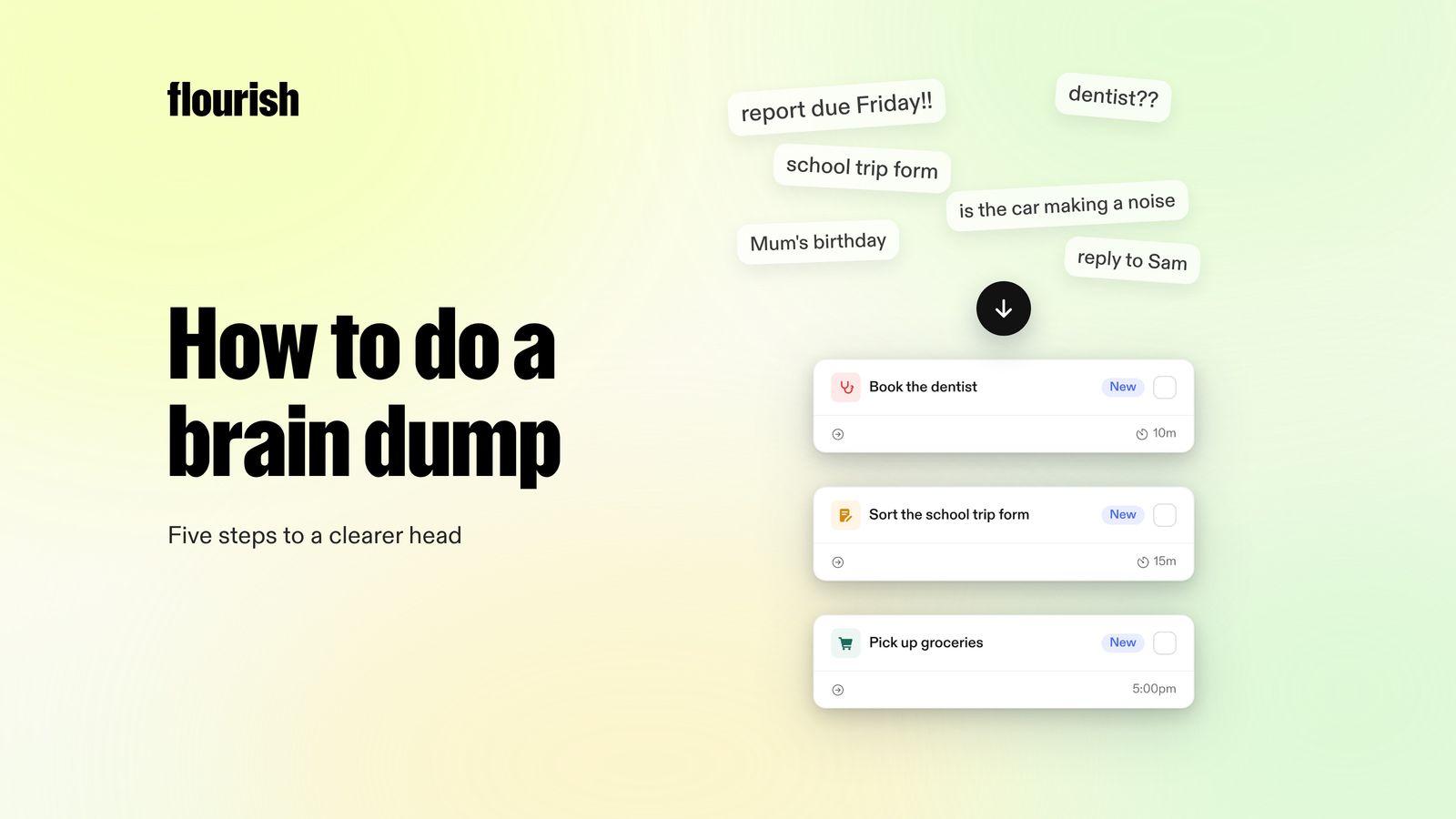
The dump: "report due Friday, haven't started. Dentist, need to book, been weeks. School trip form. Is the car making a noise? Mum's birthday on the 12th. Reply to Sam about the weekend. Gym, haven't been. Bank letter. Should I learn Spanish?"
After sorting: tasks are "write the first section of the report", "book the dentist", "fill in the school trip form", "order Mum's present" and "reply to Sam". The car is a worry, so the next step is "ask at the garage". Spanish is an idea for later. The gym becomes "book one class this week". The one thing for today: the first section of the report, at 9am.
Paper, voice or app?
Any of them works. Choose the one you will actually use:
- Paper: no distractions, and crossing things out feels good. The downside is that lists get lost and you cannot search them.
- A notes app: always with you and searchable, but easy to let one long note grow forever.
- Voice: the fastest way to get everything out, especially when you are overwhelmed or out walking. You still need something to turn the ramble into a list.
- A brain dump app: does the sorting and prioritising for you. Our guide to the best brain dump apps compares seven.
Where Flourish fits

Flourish is an AI coaching app built around the brain dump. You talk, and ramble everything on your mind. Flourish turns that ramble into tasks, prioritises them, and gives you one clear to-do for the day, which also shows on your lock screen. In other words, it does steps two to four for you.
Then Flourish handles step five. Its coach reaches out proactively to help you plan, to challenge what you are about to do next and to keep you accountable, so the dump turns into action instead of another list. It connects your calendar, wearables and Gmail inbox, so it plans around the day you actually have. It is available on iOS and Android.
Brain dump tips for ADHD brains
A brain dump is especially useful when attention jumps and everything feels equally urgent. A few adjustments help:
- Keep it short and frequent. Two minutes daily beats an hour once a month.
- Say it out loud. Talking keeps pace with racing thoughts better than writing.
- Do not let sorting become the task. If sorting stalls you, skip straight to picking one thing.
- Make the one thing visible. A lock screen or a sticky note on the laptop works better than a list in a drawer.
If you are stuck even after the dump, our guide to ADHD paralysis has more ways to get started, and our guide to the mental load explains why the list in your head keeps refilling.
The bottom line
A brain dump works because it turns a head full of open loops into a list you can see and a single next step you can take. Dump for ten minutes, sort into tasks, worries, ideas and things to drop, pick one thing, give it a time, and repeat when your head fills up. Paper is enough to start. If you would rather talk it out and have the sorting done for you, Flourish turns a spoken brain dump into one clear to-do and checks in so it happens.
Frequently asked questions
How long should a brain dump take?
Around ten minutes is enough for most people: five to ten minutes to get everything out, then a few minutes to sort it and choose one thing. A daily brain dump can be as short as two minutes once you are in the habit. A big one after a hectic week might take longer, and that is fine.
Should I do a brain dump in the morning or at night?
Either works, so pick the time you will stick to. A morning dump helps you start the day with one clear priority. An evening dump helps you switch off, and one sleep study found that writing a specific to-do list before bed helped people fall asleep faster than writing about tasks they had already finished.
What is the difference between a brain dump and a to-do list?
A brain dump is the messy first step: everything on your mind, unsorted, including worries and ideas. A to-do list is what you make from it: only the actions, written as clear next steps, with the most important one chosen for today. Doing the dump first means the to-do list is built from everything, not just what you remembered.
What do I do with a brain dump after I write it?
Sort it. Mark each item as a task, a worry, an idea or something to drop, and rewrite tasks as specific next steps. Then pick the one task that matters most today, give it a time, and move everything else to one place you trust, such as a single notes page or a task app.
Can I do a brain dump by talking instead of writing?
Yes, and many people find it easier. Talking is faster than writing and keeps up with racing thoughts. Record a voice note and sort it later, or use an app such as Flourish that turns what you say into a prioritised task list with one clear to-do for the day.
Keep reading

Julian
Flourishing Writer