Decision Fatigue: Why You Can't Decide What to Do Next
Decision fatigue is the worn-out feeling that makes the next choice harder after a day of many small ones. Here is what the research does and does not show, the signs to look for, and how to make fewer decisions.
By Julian · · 7 min read
The short version
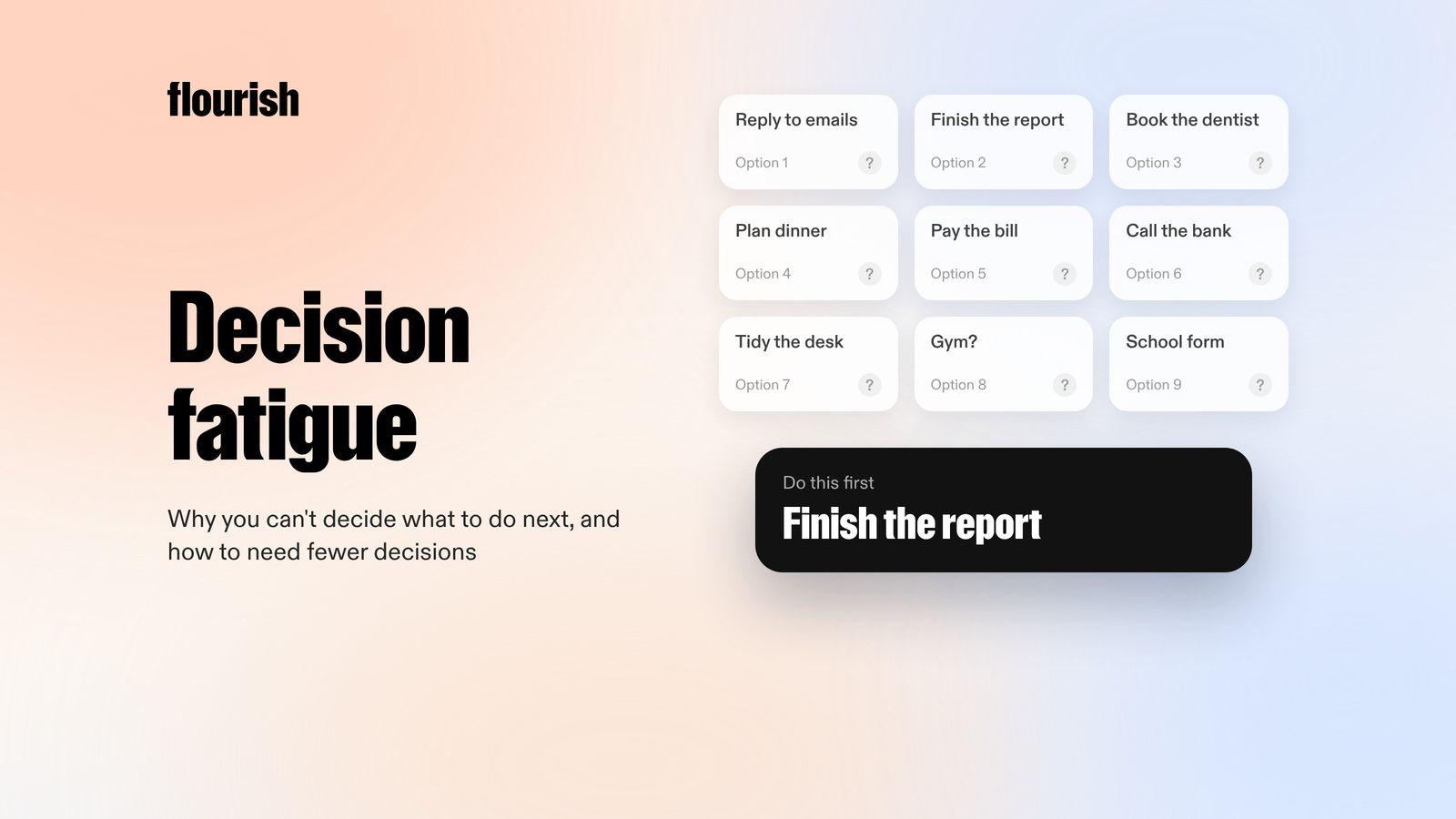
Decision fatigue is the feeling that every choice gets harder after you have already made lots of them, so by the evening even "what's for dinner?" feels impossible. If you cannot decide what to do next, the fix is usually not more willpower but fewer decisions: decide the important things once, ahead of time, and make the daily choice as small as possible. Pick one thing to do first, use defaults for everything routine, and let a list, a routine or a tool carry the rest. Flourish is built for exactly this: you talk through everything on your mind and it gives you one clear to-do for the day, so the hardest decision is already made.
The science behind decision fatigue is more mixed than the headlines suggest. But the everyday experience is real, and the solutions work either way.
What is decision fatigue?
Decision fatigue describes the idea that making decisions uses up something, energy, attention or motivation, so that the more choices you make, the worse the next ones get. When it sets in, people tend to do one of three things: put the decision off, take the default or easiest option, or decide impulsively just to be done.
It is closely tied to the mental load: the constant background work of noticing, planning and choosing for a household or a job. Our guide to the mental load explains how those invisible decisions add up.
What does the research actually show?
The idea became famous through a few striking studies, and some of them have not held up as well as they first seemed.
- The original lab work. In 2008, researchers found that people who had just made a series of choices showed less self-control and persistence afterwards than people who had only thought about the options. This fed the wider theory of "ego depletion": that self-control draws on a limited resource.
- The replication problem. When 23 labs ran a large pre-registered test of ego depletion, they found an effect close to zero. A later 36-lab replication led by one of the theory's own authors also found no evidence for a depletion effect.
- The parole judges. A widely quoted 2011 study found that favourable parole rulings fell from about 65% to nearly zero across each session, then jumped back after a food break. Later analysis suggested much of that pattern could be a statistical artefact of favourable rulings simply taking longer than unfavourable ones.
- The doctors. A study of more than 21,000 primary care visits found antibiotic prescribing rose as clinic sessions went on, which the authors linked to decision fatigue.
So the honest summary is this: the strong claim, that willpower is a fuel tank that empties with every choice, is in doubt. The weaker claim, that long stretches of decisions make people more likely to stall or take the easy option, still has support, and it matches what most people feel at the end of a long day.
Why can't I decide what to do next?
Even setting the theory aside, there are plain reasons the next decision feels so hard:
- Everything is still in your head. If your options are not written down, you are comparing them from memory, which is tiring and never finished.
- The list is too long. Choosing from forty tasks is harder than choosing from three. Research on choice overload is mixed, but a large meta-analysis found too many options does make choosing harder when the choices are complex and you are unsure what you want, which is exactly what a long to-do list is like.
- Everything looks equally urgent. Without a clear priority, every task asks to go first. This is a common pattern in ADHD paralysis.
- Nothing is decided in advance. If meals, routines and the next step all get decided in the moment, the day becomes one long string of small choices.
- You are tired or stressed. Low sleep and high stress make every choice feel heavier, whatever the cause.
Signs of decision fatigue
Look out for these:
- Putting off small decisions you would normally make in seconds.
- Saying "I don't mind, you choose" far more than usual.
- Scrolling, cleaning or reorganising instead of starting the important task.
- Snapping at simple questions late in the day.
- Impulse buying or ordering takeaway because deciding anything else feels too much.
- Ending the day busy but with the one thing that mattered still not started.
How to beat decision fatigue

1. Decide the night before
Choose tomorrow's one most important task before you finish today, while you can still see the whole picture. In the morning, the decision is already made and you only have to start. A short brain dump in the evening makes this easier.
2. Make one decision, not forty
Instead of ranking your whole list, pick one thing that would make today feel lighter. Then do it before you reconsider anything else. One clear priority beats a perfectly ordered list you never act on.
3. Use defaults for routine choices
Repeat what works: the same breakfast on weekdays, a standing weekly meal plan, a fixed time for admin, a uniform for the gym. Every default is one less decision in the moment.
4. Batch the small stuff
Group small decisions and make them in one sitting: reply to all the emails at 4pm, plan the week's meals on Sunday, pay bills on the same day each month. Ten small decisions in a row feel lighter than ten scattered through the day.
5. Do the important decisions early
If you have something important to decide, do it when you are freshest, which for most people is earlier in the day, rather than after a run of meetings.
6. Hand some decisions off
Share household decisions with a partner by agreeing who owns each one, not who helps. And let tools carry the routine: a calendar that holds the plan, a list that holds the tasks, or a coach that picks the next step.
Where Flourish helps

Flourish is an AI coaching app designed to shrink the daily decision to one. You talk, and ramble everything on your mind. Flourish turns that ramble into tasks, prioritises them, and gives you one clear to-do for the day, which also shows on your lock screen, so you are not choosing from forty options every time you look at your phone.
Flourish also takes on the follow-up decisions. Its coach reaches out proactively to help you plan, to challenge what you are about to do next and to keep you accountable, and it connects your calendar, wearables and Gmail inbox so it plans around the day you actually have. It is available on iOS and Android. If you would rather build your own system, our guide to simpler alternatives to GTD compares low-effort methods like the Ivy Lee list and the 1-3-5 rule.
When is it more than decision fatigue?
Feeling worn out by decisions now and then is normal. If you are constantly overwhelmed, struggling to start even simple tasks, or your mood, sleep or work are suffering, it is worth speaking to your GP. Ongoing trouble with planning, deciding and starting can also be a sign of ADHD in adults, and our guide to the best ADHD apps for adults covers tools that can help alongside proper support.
The bottom line
You probably cannot decide what to do next because you are being asked to make too many decisions, too late in the day, from a list that lives in your head. Whatever the science finally says about willpower, the fix is the same: decide in advance, use defaults, and shrink each day to one clear priority. Flourish is our pick if you want that daily decision made with you: you talk it all out, it picks one clear to-do, and the coach checks in.
Frequently asked questions
Is decision fatigue real?
The everyday experience is real: long stretches of decisions can leave people more likely to stall, delay or take the easiest option. The stronger scientific claim, that willpower is a limited fuel that every choice uses up, has struggled in large replication studies. Either way, reducing the number of decisions you make each day tends to help.
What are the symptoms of decision fatigue?
Common signs include putting off small decisions, saying "you choose" more than usual, procrastinating on important tasks, feeling irritable late in the day, impulse buying and going for the easiest option by default. Many people notice it most in the evening, when even simple choices like what to eat feel like too much.
How do I stop decision fatigue?
Make fewer decisions in the moment. Decide tomorrow's most important task the night before, use defaults for routine choices like meals and clothes, batch small decisions together, make important decisions earlier in the day, and let a list, routine or app carry the rest. Choosing one priority instead of ranking a long list helps most.
Is decision fatigue a sign of ADHD?
Not on its own. Everyone experiences decision fatigue sometimes. But many adults with ADHD describe finding it especially hard to prioritise when every task feels equally urgent. If difficulty planning, deciding and starting has been a long-standing pattern that affects your daily life, it is reasonable to ask your GP about an assessment.
Why is it so hard to decide what to eat?
By dinnertime, you have usually made hundreds of small choices, and food has lots of options, people to please and no clear right answer. That combination makes it a classic decision fatigue moment. A standing weekly meal plan or a few go-to defaults removes the decision when you are least able to make it.
This article is for general information and is not medical advice. If you are worried about your health, speak to your GP or a qualified clinician.
Keep reading

Julian
Flourishing Writer