Getting Things Done (GTD) Is Too Complicated: Simpler Alternatives
GTD works, but its lists, contexts and weekly review are a lot to keep up. Here are simpler systems that keep the best part of GTD, getting everything out of your head, without the upkeep.
By Julian · · 9 min read
The short version
If Getting Things Done feels like too much, keep its first step and drop most of the rest. The part of GTD that does the heavy lifting is capture: getting everything out of your head and into one trusted place. The simpler alternatives keep that and replace the lists, contexts and weekly review with one small daily decision. Flourish is our top pick if you want the system to run itself: you talk through everything on your mind, it sorts and prioritises it into one clear to-do, and a coach checks in. If you prefer pen and paper, the Ivy Lee method, the 1-3-5 rule, eat the frog and personal kanban are all simpler than GTD and take minutes to learn.
GTD is not a bad system. Plenty of people swear by it. But it asks for a lot of ongoing upkeep, and when life gets busy, the upkeep is the first thing to go. This guide explains why that happens and which simpler systems hold up better.
What is GTD, and why does it feel so complicated?
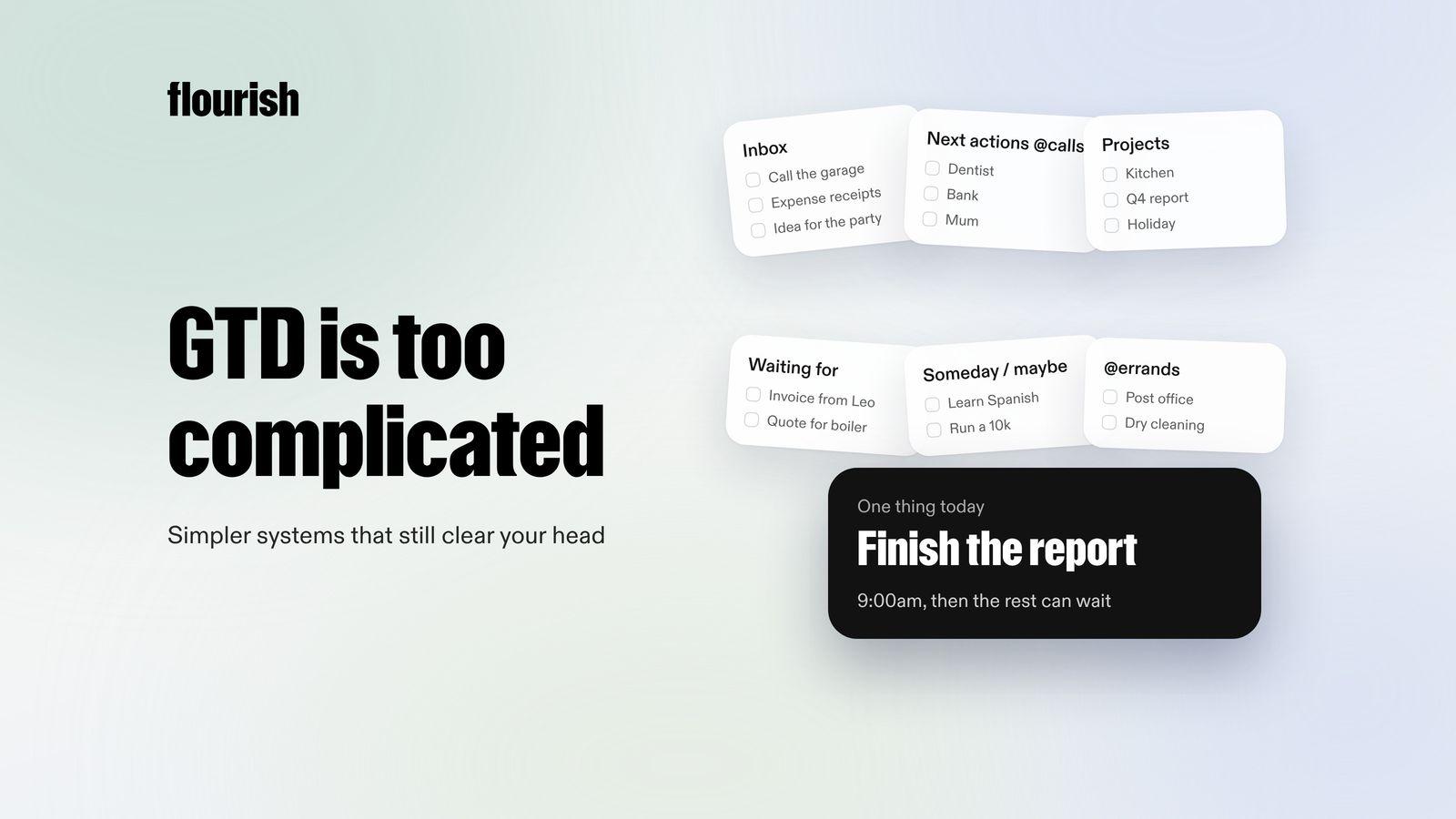
Getting Things Done is the productivity method David Allen first published in 2001. The official version has five steps: capture what has your attention, clarify what it means, organise it where it belongs, reflect on it regularly, and engage, which simply means do it. Along the way you sort single actions onto next action lists by context (calls, computer, errands, home), turn anything with more than one step into a project, keep a someday/maybe list, and do anything that takes under two minutes straight away, the two-minute rule.
Each piece makes sense. Together, they add up to a lot of moving parts. In our experience, people find GTD complicated for three reasons:
- Too many lists. Inbox, next actions by context, projects, waiting for, someday/maybe and a calendar all need tending.
- Too much processing. Every captured item needs a decision about what it is and where it goes before you can do anything with it.
- The weekly review. GTD's own podcast calls the weekly review the critical success factor, and productivity writer Tiago Forte describes it as the most difficult habit to maintain. When it slips, the lists go stale and stop being trusted.
Leo Babauta made the same point years ago in his critique of GTD, noting that GTD is a series of habit changes and that it does not focus enough on doing. If you have ever spent a Sunday reorganising your system instead of using it, you know the feeling.
What should a simpler system keep from GTD?
The best idea in GTD is that your head is for having ideas, not holding them. Writing everything down really does help: in one set of experiments, making a specific plan for an unfinished goal stopped it from intruding on people's thoughts while they did something else. So any simpler system should keep three things:
- Capture everything in one place. A brain dump beats a dozen sticky notes.
- Decide the next step. A task like "sort the car" is a worry, not an action.
- Choose what matters today. This is where GTD gives you many lists, and the simpler systems give you one short one.
What a simpler system can drop is the sorting by context, the separate project lists and the heavy weekly review.

Simpler alternatives to GTD
1. Flourish: best if you want GTD's capture without the upkeep

Flourish is an AI coaching app for people with a million things in their head and no obvious place to start. It keeps GTD's best habit, capture, and does the clarifying and organising for you. You talk, and ramble everything on your mind: the report, the dentist, the form that is due on Friday. Flourish turns that ramble into tasks, prioritises them, and gives you one clear to-do for the day, which also shows on your lock screen.
Then the coach does the part of the weekly review most people skip. Flourish reaches out proactively to help you plan, to challenge what you are about to do next, and to keep you accountable, so the system does not depend on you remembering to maintain it. It connects your calendar, wearables and Gmail inbox, so it sees the day you actually have.
- Best for: people who like GTD's promise of a clear head but cannot keep the lists up to date.
- Platforms: iOS and Android.
- Honest limitation: it does not give you context lists or a project tree. If you love tending a detailed system, a GTD app will suit you better.
Why it is our top pick: GTD fails when the upkeep slips, and Flourish removes most of the upkeep. You talk once, get one priority, and something checks in later. If you want to compare it with other planners, our guide to the best AI planner apps sorts them by what their AI actually does.
2. The Ivy Lee method: best on paper
The Ivy Lee method is about as simple as a system gets. At the end of each day, write down the six most important things to do tomorrow, rank them in order of importance, then work through them one at a time the next day, starting at the top. Anything unfinished moves to the next day's list of six.
- Best for: people who want one short ranked list and nothing else.
- Honest limitation: it relies on you sitting down every evening to choose, which is exactly the habit that slips on hard days.
3. The 1-3-5 rule: best for a realistic day
The 1-3-5 rule, popularised by The Muse, plans each day as one big thing, three medium things and five small things. Nine items is enough to make progress and few enough to finish, and you can leave slots empty on busy days.
- Best for: people whose days mix one important project with lots of small admin.
- Honest limitation: you still have to decide what goes in each slot, and nine things can still feel like a lot.
4. Eat the frog: best if you keep avoiding one task
Brian Tracy's Eat That Frog boils productivity down to one rule: do the most important task you are putting off first, before anything else. Leo Babauta's Zen To Done uses a similar idea, picking one to three most important tasks each day.
- Best for: people who are busy all day but never get to the thing that matters.
- Honest limitation: it tells you to start with the hardest thing, but not how to work out which thing that is. If starting is the problem, our guide to ADHD paralysis covers what helps.
5. Personal kanban: best if you think visually
Personal kanban, from Jim Benson and Tonianne DeMaria, has two rules: visualise your work and limit your work in progress. In practice that means a board with columns, often to do, doing and done, and a firm cap on how much can sit in doing at once.
- Best for: visual thinkers and people who start too many things at once.
- Honest limitation: a board shows everything at once, which can be overwhelming when the to do column is long.
6. A simpler app: Todoist, Things or TickTick
If you like GTD's ideas but want an app that is easier to live with, a good task manager can carry a lighter version. Todoist has an official GTD guide built around its inbox, projects and labels, and its AI can turn a spoken ramble into tasks. Things 3 keeps to a few clean lists, Inbox, Today, Upcoming, Anytime and Someday, on Apple devices only. TickTick adds an Eisenhower matrix, a focus timer and habits (TickTick).
- Best for: people who want a dependable list and some structure.
- Honest limitation: a list shows you everything that is due. It will not choose today's priority or check in on you.
Side by side
- Flourish: what you keep from GTD: capture. Daily effort: talk for a minute. Review: the coach checks in.
- Ivy Lee method: what you keep: a next action list. Daily effort: five minutes each evening. Review: none.
- 1-3-5 rule: what you keep: a daily list. Daily effort: five minutes. Review: none.
- Eat the frog: what you keep: one most important task. Daily effort: one decision. Review: none.
- Personal kanban: what you keep: a visible list. Daily effort: moving cards. Review: light, as you go.
- GTD in full: what you keep: everything. Daily effort: processing your inbox. Review: weekly.
How do you choose the right system?
Start from where GTD broke down for you:
- "I capture everything but never process it." Try Flourish, which sorts the capture for you.
- "I have too many lists." Try the Ivy Lee method or the 1-3-5 rule.
- "I avoid the one thing that matters." Try eat the frog.
- "I start everything and finish nothing." Try personal kanban.
- "I just want a good app." Try Todoist, Things or TickTick.
Whatever you pick, keep it small enough that you can still run it on your worst week. A system you use on bad days beats a perfect one you abandon. If too many choices is part of the problem, our guide to decision fatigue explains why the decisions themselves wear you out. And if you would rather start with a chatbot, our guide on how to use ChatGPT to plan your day shows how to run a simple daily plan with prompts.
The verdict
GTD is a complete system, and that is its weakness: it only works while you maintain all of it. The simpler alternatives keep the capture and make the daily decision smaller. Flourish is our pick if you want the system to run itself, because it turns a spoken brain dump into one clear priority and then checks in so it happens. The Ivy Lee method is the best paper option, the 1-3-5 rule is the most realistic for mixed days, eat the frog is best for avoided tasks and personal kanban suits visual thinkers. For a planner that does more of the scheduling, see our roundup of Sunsama alternatives.
Frequently asked questions
Is GTD still worth learning?
Yes, if you enjoy systems and will keep up the weekly review. Its core ideas, capturing everything, deciding the next action and reviewing regularly, are sound. Many people get most of the benefit by adopting just the capture habit and a short daily list, without the context lists and full weekly review that make the method hard to maintain.
What is the simplest alternative to GTD?
The Ivy Lee method is one of the simplest. Each evening you write down the six most important things for tomorrow, rank them, and work through them in order the next day, moving anything unfinished to the next list. If you would rather not plan every evening, an app like Flourish turns a spoken brain dump into one clear to-do for you.
Why is GTD so hard to stick to?
GTD asks for several habits at once: capturing everything, processing every item, sorting by context and reviewing every week. When life gets busy, the processing and the weekly review are usually the first to slip, the lists go stale, and the system stops being trusted. Simpler systems last longer because they ask for less upkeep.
Is there a GTD app that does the work for you?
Most GTD apps, such as Todoist, Things and Nirvana, help you keep the lists, but you still do the clarifying and organising. Flourish works differently: you talk through everything on your mind, it turns that into prioritised tasks with one clear to-do for the day, and a coach checks in so you do not have to maintain the system yourself.
What is the difference between GTD and the 1-3-5 rule?
GTD is a complete system for capturing and organising everything you might ever do. The 1-3-5 rule only plans today: one big task, three medium ones and five small ones. Many people combine them, capturing everything in one place and then choosing a 1-3-5 list from it each morning.
Keep reading

Julian
Flourishing Writer