What Is the Mental Load, and How Do You Reduce It?
The mental load is the invisible work of running a life or a household: noticing what needs doing, planning it, deciding and keeping track. Here is what it is, why it is so tiring, and practical ways to make it lighter.
By Julian · · 8 min read
The short version
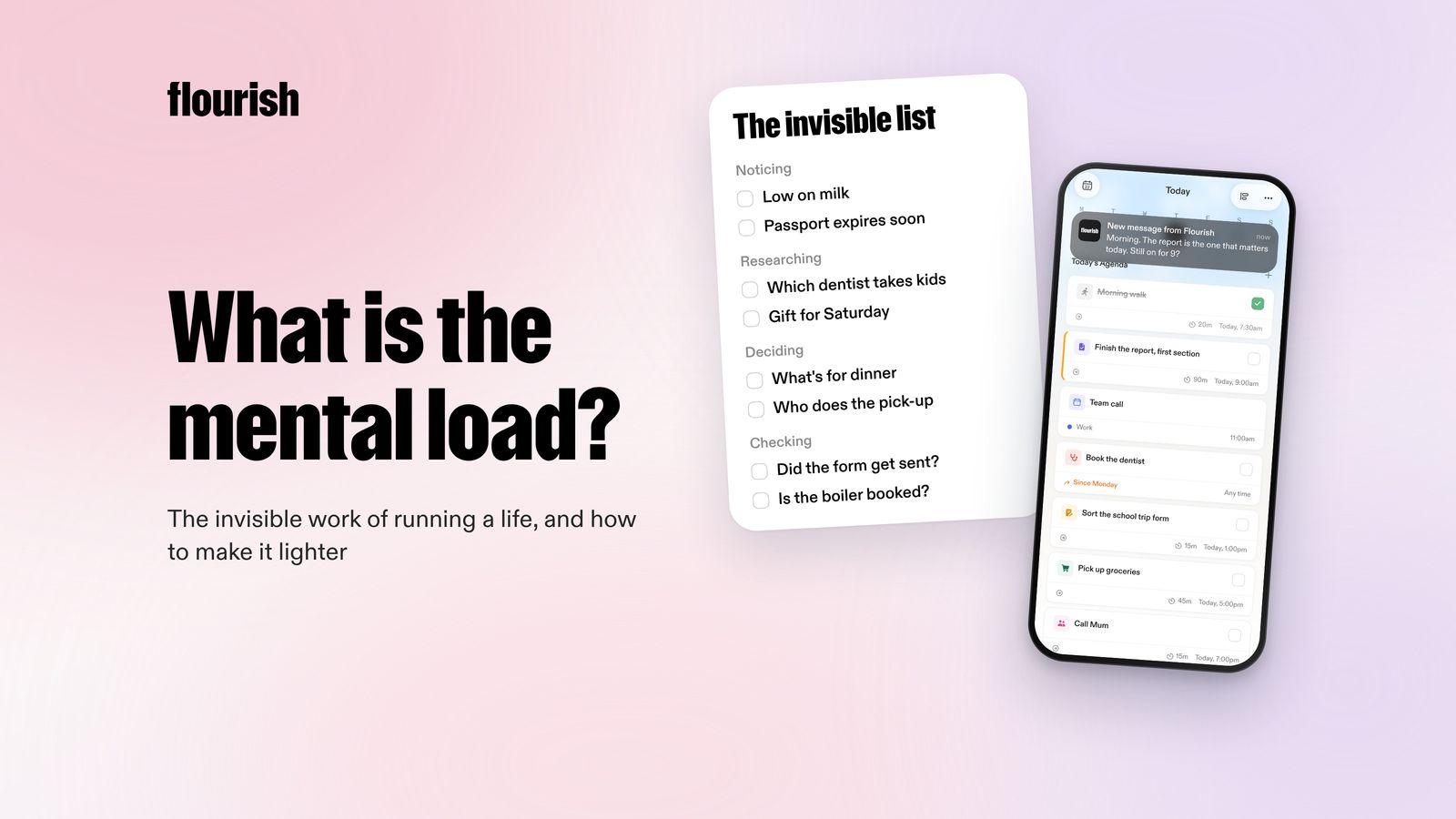
The mental load is the invisible thinking work of running a life or a household: noticing what needs doing, working out the options, deciding, and keeping track until it is done. It is remembering the school form, noticing you are low on milk, booking the dentist and checking it actually happened. It is tiring because it never stops and nobody sees it. You reduce it in three ways: get it out of your head into one place, share ownership of whole jobs rather than handing out tasks, and make fewer decisions by using defaults. Tools help with the first and the last: Flourish lets you talk everything out, turns it into a prioritised plan with one clear to-do, and checks in so you are not the only one keeping track.
What is the mental load?
The mental load, sometimes called cognitive labour or invisible labour, is the planning and organising that sits behind visible chores. Cooking dinner is a chore. Knowing there is nothing in for dinner, deciding what to make, remembering who will not eat what, and adding the missing things to the shopping list is the mental load.
Sociologists have studied it for decades. In a 1996 study of new parents, Susan Walzer described the "thinking about the baby" that mothers did far more of: worrying, gathering information and managing the division of care. The term reached a much wider audience in 2017 through the French cartoonist Emma's comic "You should've asked", which showed how being the household "manager" turns one partner into the person who has to notice and delegate everything.
The four parts of the mental load
The clearest breakdown comes from sociologist Allison Daminger, whose 2019 study of 35 couples split cognitive labour into four stages:
- Anticipating. Noticing a need before it becomes a problem: the kids will need new shoes, the car is due a service.
- Identifying options. Researching what could meet the need: which shoe shop, which garage, which weekend.
- Deciding. Choosing between the options.
- Monitoring. Keeping track until it is done: did the booking go through, did the shoes fit.

Daminger found women did more of this work overall, especially anticipating and monitoring, while couples shared the deciding much more evenly. That detail matters: the most visible stage, making the decision, is often shared, while the long, unseen stages before and after it are not.
Mental load examples
In our experience, the mental load hides in phrases like "I'll just remember to...". A few common examples:
- Home: noticing the bin day changed, the boiler service is due, the bathroom needs cleaning before guests arrive.
- Children: school forms, birthday parties and presents, clubs and kit, doctor and dentist appointments, what they need for next week.
- Food: what is in the fridge, what everyone eats, the shopping list, meal plans.
- Family and friends: birthdays, thank-you messages, checking in on parents, planning visits.
- Money and admin: bills, renewals, insurance, forms, subscriptions.
- Work: deadlines, follow-ups, preparing for meetings, keeping the team's plans in your head.
- Your own health: booking check-ups, refilling prescriptions, keeping exercise going.
Each item is small. The load comes from carrying all of them at once, all the time.
Why is the mental load so exhausting?
The mental load is tiring because it is constant, invisible and full of decisions.
- It never switches off. Anticipating and monitoring happen in the background all day, and often at 2am.
- It is invisible. Nobody sees you noticing that the passport expires next spring, so nobody thanks you for it or offers to take it on.
- It is mostly decisions. Each one is small, but they pile up. Our guide to decision fatigue explains why a day of small choices makes the next one harder.
It also has real effects. In a study of 393 mothers, feeling solely responsible for running the household was linked to lower well-being, including feeling overwhelmed and empty, and to lower satisfaction with their partner.
Who carries the mental load?
Anyone can, and many households split it in their own way. But research consistently finds it falls more on women, especially mothers. A 2025 survey of more than 2,000 US parents found mothers reported 67% more household management tasks than fathers, and that mothers with high-earning careers carried just as much of the mental load as other mothers.
It can be heavier still with ADHD, where remembering, planning and switching between tasks take more effort. Our guide to ADHD in women and mums covers tools for carrying that load.
How to reduce the mental load
You cannot make the mental load disappear, but you can make it lighter, more visible and more evenly shared.
1. Get it out of your head
The first step is to stop holding everything in memory. Do a brain dump: ten minutes of writing or saying everything on your mind, then sorting it into tasks, worries and ideas. Keep one place for everything, because a list split across sticky notes, texts and your head is still a list in your head.
2. Make the invisible work visible
Write down the whole job, not just the visible task. "Birthday party" is really: check the date, reply to the invite, buy a present, wrap it, sort the lift. Once it is written down, the size of the job is obvious to everyone, including you. Going through the four stages above, job by job, is a useful way to audit what you carry.
3. Share ownership, not tasks
Asking a partner to "help" still leaves you as the manager who has to notice and delegate. Instead, hand over whole jobs from anticipating to monitoring: one person owns school admin, the other owns the car, end to end. Agree who owns what in a short weekly check-in, rather than negotiating each task as it comes up.
4. Decide once and use defaults
Every decision you make in advance is one less in the moment. Use a standing meal plan, recurring reminders for bills and renewals, automatic orders for things you always buy, and fixed days for admin.
5. Choose one thing for today
When everything feels urgent, pick the one task that would make today feel lighter and do that first. The rest can wait in your list, where you know it is safe.
6. Let tools carry some of it
Shared family calendars keep everyone's plans in one place. A task app holds the list. And a coaching app can take on part of the anticipating and monitoring.
Where Flourish fits

Flourish is an AI coaching app for people with a million things in their head and no obvious place to start. You talk, and ramble everything on your mind: the school form, the report, the present you have not bought. Flourish turns that ramble into tasks, prioritises them, and gives you one clear to-do for the day, which also shows on your lock screen.
Then the coach shares the monitoring. Flourish reaches out proactively to help you plan, to challenge what you are about to do next and to keep you accountable, so keeping track does not depend on your memory alone. It connects your calendar, wearables and Gmail inbox, so it plans around the day you actually have. It is available on iOS and Android. It is a personal coach rather than a shared family calendar, so pair it with a family app if the whole household needs to see the plan.
If you want to compare tools, our guide to the best brain dump apps covers apps for getting everything out of your head, the best AI life coach apps compares coaching apps, and our guide on how to use ChatGPT to plan your day shows how to plan with a chatbot. If remembering and organising feel harder than they should, our guide to the best ADHD apps for adults may help.
When is it more than the mental load?
Everyone feels overloaded sometimes. If the load is affecting your sleep, mood, health or relationships for weeks at a time, or you feel burnt out, it is worth speaking to your GP. A counsellor or couples therapist can also help if the division of work at home has become a source of conflict.
The bottom line
The mental load is the invisible work of anticipating, researching, deciding and keeping track, and it is heavy because it never stops and nobody sees it. Get it out of your head, make the whole job visible, share ownership of complete jobs, decide routine things once, and pick one thing for today. Flourish can carry part of it with you: talk everything out, get one clear priority, and let the coach help keep track.
Frequently asked questions
What is the mental load in simple terms?
The mental load is the invisible thinking work of running a life or a household. It is noticing what needs doing, working out the options, making the decisions and keeping track until things are done. Cooking dinner is a chore; knowing there is nothing in, deciding what to make and adding the missing items to the shopping list is the mental load.
What are examples of the mental load?
Common examples include remembering birthdays and buying presents, keeping track of school forms and clubs, booking doctor and dentist appointments, noticing when household supplies run low, planning meals, remembering bills and renewals, and checking that things actually got done. Each task is small, but carrying all of them at once is what makes it heavy.
Why do women carry more of the mental load?
Research consistently finds that women, and mothers in particular, do more of the anticipating and monitoring parts of household work. Explanations include social expectations about who manages the home and the fact that once one partner becomes the household manager, the other tends to wait to be asked. Sharing ownership of whole jobs is one of the most effective ways to rebalance it.
How do I talk to my partner about the mental load?
Start with the work rather than blame. Write down everything it takes to run the household, including the invisible steps, and go through the list together. Then agree who owns each whole job from start to finish, rather than who helps with tasks. A short weekly check-in keeps the split fair as things change.
Can an app help with the mental load?
An app cannot do the thinking for you, but it can carry some of it. A shared family calendar makes plans visible to everyone. A coaching app like Flourish lets you talk through everything on your mind, turns it into one clear priority for the day and checks in later, so you are not the only one keeping track.
Keep reading

Julian
Flourishing Writer