ADHD in Women and Mums: Tools for Carrying the Load
How ADHD often shows up in women and mums, why family life can make it harder to manage, and the apps and habits that help with remembering, deciding, starting and keeping the household in sync.
By Julian · · 8 min read
The short version
ADHD in women often looks different from the hyperactive stereotype: more forgetfulness, racing thoughts and quiet overwhelm, which is one reason it can go unrecognised for years. For mums, family life adds a constant stream of things to remember and decide, which can push a manageable brain past its limit. The tools that help most take that load out of your head. Flourish is our top pick for that: you talk through everything on your mind, it turns it into a prioritised plan with one clear to-do, and a coach checks in. Cozi keeps the family calendar and lists shared, Tiimo makes the day visual, Goblin Tools breaks tasks down, and Routinery talks you through routines.
This guide is for women who have a diagnosis, suspect they might, or simply recognise themselves in the description. It is not a diagnosis, and an app is not treatment. But the right tools can make the daily load lighter, and that matters.
How does ADHD show up in women?
Women and girls have the same core ADHD symptoms as men and boys, but the way those symptoms show in behaviour can look different (CHADD). Girls and women more often appear to have the inattentive presentation: careless mistakes, trouble sustaining attention, forgetfulness, losing things and avoiding tasks that take sustained mental effort. Many also describe "internal" hyperactivity, such as racing thoughts, talking a lot or fidgeting.
Because clinicians have often looked for a hyperactive, disruptive "male model" of ADHD, women's symptoms have historically been put down to other causes, which CHADD links to underdiagnosis. The NHS notes that ADHD is recognised less often in girls than boys, possibly because inattentive symptoms are harder to spot. Many women also compensate by working much harder than the people around them, which can hide the difficulty until life gets busier.
If this sounds familiar, speak to your GP or a qualified clinician. Only an assessment can tell you whether it is ADHD.
Why can motherhood make ADHD harder?
Family life is, in practical terms, a job made of the things ADHD brains find hardest: remembering many small things, switching between them, and starting tasks nobody will praise you for. Forms, appointments, birthdays, meals, uniforms, the work deadline and the dentist all compete for the same limited attention, and most of them have no fixed time and no one reminding you.
In our experience, the load breaks down into five jobs:
- Remembering. Keeping track of everything that needs doing, for everyone.
- Deciding. Choosing what matters today when it all feels urgent.
- Starting. Getting going on tasks that are dull or vague.
- Routines. Mornings, bedtimes and the transitions in between.
- Sharing. Making sure the rest of the household sees what you see.

Different tools help with different jobs. Most women do best with one or two, not a whole stack.
Tools that help with ADHD as a woman and mum
1. Flourish: best for getting it all out of your head

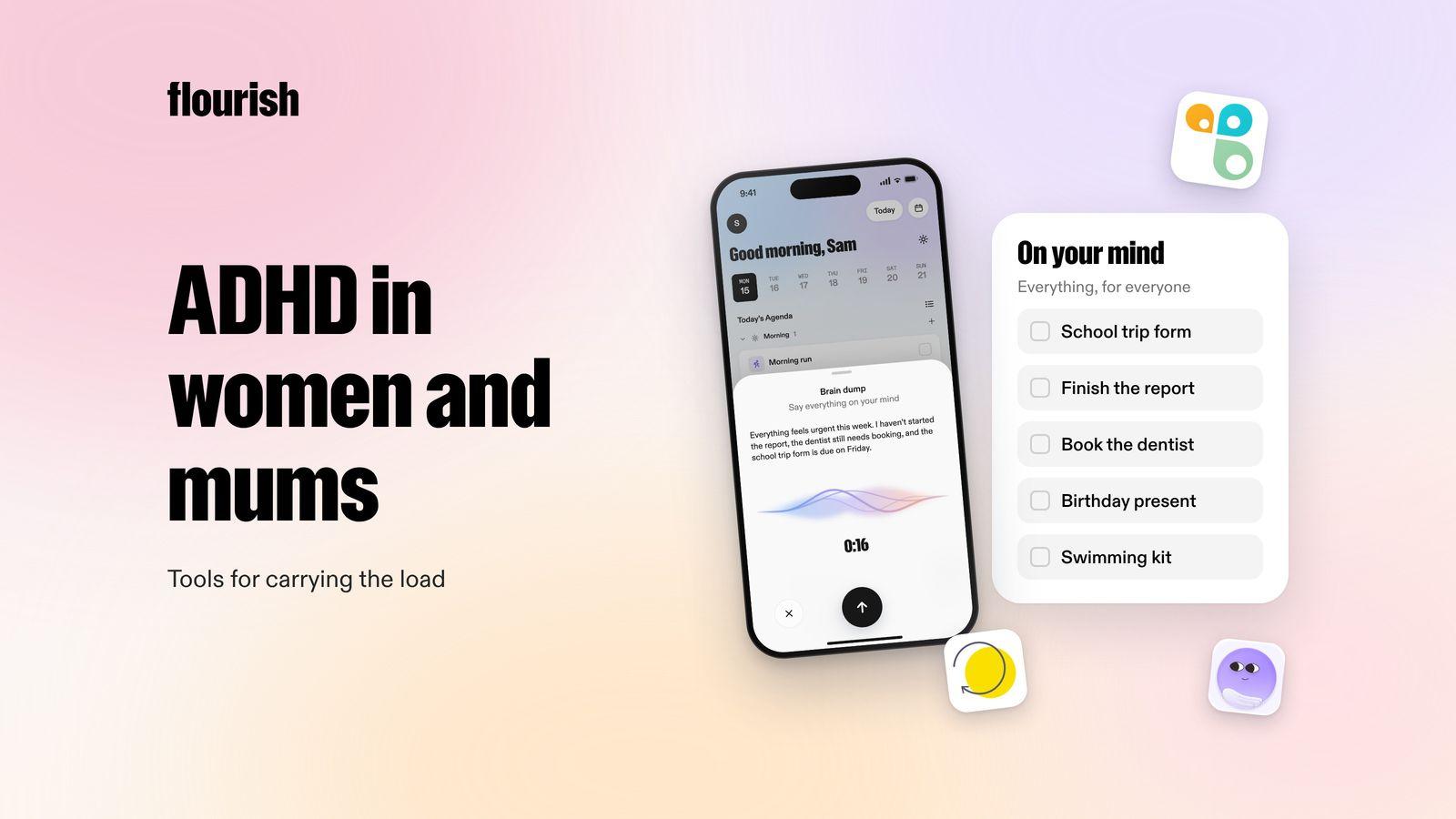
Flourish is an AI coaching app for people with a million things in their head and no obvious place to start. You talk, and ramble everything on your mind: the school trip form, the report due Friday, the present you have not bought. Flourish turns that brain dump into tasks, prioritises them, and gives you one clear to-do for the day, which also shows on your lock screen.
Then the coach shares the load. Flourish reaches out proactively to help you plan, to challenge what you are about to do next, and to keep you accountable, so the plan does not depend on you remembering to open an app. It connects your calendar, wearables and Gmail inbox, so it can see the day you actually have, school run included.
- Best for: the remembering and deciding jobs, when everything lives in your head.
- Platforms: iOS and Android.
- Honest limitation: it is your personal coach, not a shared family calendar. Pair it with a family app if the household needs to see the plan too.
Why it is our top pick: the hardest part of carrying the load is that it never leaves your head. Talking it out, getting one clear priority and having something check in later is the closest thing to handing part of it to someone else. If starting is where you get stuck, our guide to ADHD paralysis explains what helps in the moment.
2. Cozi: best for sharing the family load
Cozi is a family organiser built around one shared account. It has a colour-coded shared calendar with reminders and agenda emails, shopping lists everyone can update, to-do and chore lists that sync in real time, and a meal planner that sends ingredients to the shopping list. There is a free version (Cozi).
- Best for: the sharing job, so your partner or older children can see and take on tasks.
- Platforms: iPhone, Android and web.
- Honest limitation: it holds the family's plans, but it will not decide what matters most for you today.
3. Tiimo: best for a visual day
Tiimo turns your schedule into a colourful visual timeline, with an AI co-planner that turns typed or spoken tasks into a schedule, a focus timer that shows time passing, and widgets so your next task is always visible (Tiimo). It is designed with ADHD and autism in mind.
- Best for: women who think visually and find it calming to see the day laid out.
- Platforms: iOS, iPadOS, watchOS, Android and web.
- Honest limitation: family days rarely go to plan, and rebuilding a timeline takes energy. Our guide to Tiimo alternatives covers other options.
4. Goblin Tools: best free help for getting started
Goblin Tools is a free, ad-free set of small AI tools for neurodivergent people. Magic ToDo breaks a task like "sort the kids' wardrobes" into steps, Estimator guesses how long it will take, and Compiler turns a typed brain dump into actions (Goblin Tools).
- Best for: the starting job, when a task is too vague to begin.
- Platforms: web, with paid iOS and Android apps.
- Honest limitation: the developer says output is guesswork, and it does not plan the day or follow up.
5. Routinery: best for mornings and bedtimes
Routinery turns a routine into an ordered checklist with a timer for each step, and talks you through it with voice alerts so you know what comes next. You can pause, skip or add steps, start from ready-made routines and track streaks (Routinery).
- Best for: the routines job, especially the morning rush.
- Platforms: iPhone, iPad, Mac, Apple Watch and Android.
- Honest limitation: it is for repeating routines, not one-off tasks or deciding what matters.
Side by side
- Flourish: job: remembering and deciding. Shared with family: no, personal. Follows up: yes, a proactive coach.
- Cozi: job: sharing. Shared with family: yes. Follows up: reminders and agenda emails.
- Tiimo: job: seeing the day. Shared with family: no. Follows up: timers and widgets.
- Goblin Tools: job: starting. Shared with family: no. Follows up: no.
- Routinery: job: routines. Shared with family: no. Follows up: voice alerts during a routine.

Habits that make the tools work
Apps help most when a few simple habits hold them up:
- One place for everything. If it is not in the app, it is still in your head.
- A daily two-minute dump. Talk or type everything out each morning or the night before.
- One thing first. Pick the single task that would make today feel lighter, and do that before the rest.
- Make the load visible. A shared list turns invisible work into tasks someone else can take.
- Plan for bad days. Decide in advance what the minimum version of a day looks like.
If you want a wider comparison, our guide to the best ADHD apps for adults groups tools by the job they do, and our ADHD planner apps guide covers planning in more depth.
When to get more support
Tools are a support, not a substitute for care. Consider speaking to your GP or a clinician if you are struggling to keep up at work or at home, if you recognise long-standing ADHD traits, or if low mood or anxiety are building. An ADHD coach can also help with routines and accountability, and our comparison of an ADHD coach and an AI coach explains how they differ.
The verdict
The best tools for ADHD as a woman and mum are the ones that take the load out of your head and share it. Flourish is our pick for the remembering and deciding, because it turns a spoken brain dump into one clear priority and then checks in so it happens. Cozi is best for sharing the family load, Tiimo for a visual day, Goblin Tools for getting started for free, and Routinery for mornings and bedtimes.
Frequently asked questions
How is ADHD different in women?
The core symptoms are the same, but they can look different. Women and girls more often show inattentive signs such as forgetfulness, losing things and difficulty sustaining attention, and many describe racing thoughts rather than visible hyperactivity. Because this does not fit the stereotype, it can go unrecognised for years. Only a clinical assessment can confirm ADHD.
What is the best app for mums with ADHD?
It depends on which part of the load is hardest. Flourish is a strong choice for getting everything out of your head and deciding what matters, because it turns a voice brain dump into one clear to-do and a coach checks in. Cozi is best for sharing calendars and lists with the family, and Routinery helps with morning routines.
Can an app help with ADHD overwhelm?
An app can reduce overwhelm by taking things out of your head, shrinking the list to one priority and reminding you where you will see it. It cannot treat ADHD. If overwhelm is affecting your health, work or relationships, it is worth speaking to your GP or a qualified clinician about assessment and support.
How do I share the mental load with my partner?
Make the invisible work visible. Write everything down in one shared place, such as a family organiser like Cozi, and agree who owns each recurring job rather than who helps with it. A weekly ten-minute check-in to divide the coming week's tasks helps more than asking for help in the moment.
Should I get assessed for ADHD as an adult woman?
If you recognise long-standing difficulties with attention, organisation or follow-through that affect your daily life, it is reasonable to ask your GP about an assessment. It is never too late to ask: plenty of people are first assessed as adults, once they notice the strategies that used to work no longer keep up. A clinician can talk you through the options.
This article is for general information and is not medical advice. If you are worried about your health, speak to your GP or a qualified clinician.
Keep reading

Julian
Flourishing Writer