Feeling Overwhelmed by Everything? What to Do in the Next 10 Minutes
When everything feels like too much, you do not need a new system. You need ten minutes: breathe, name it, get it all out of your head, pick one small thing and start. Here is how, minute by minute.
By Julian · · 9 min read
The short version
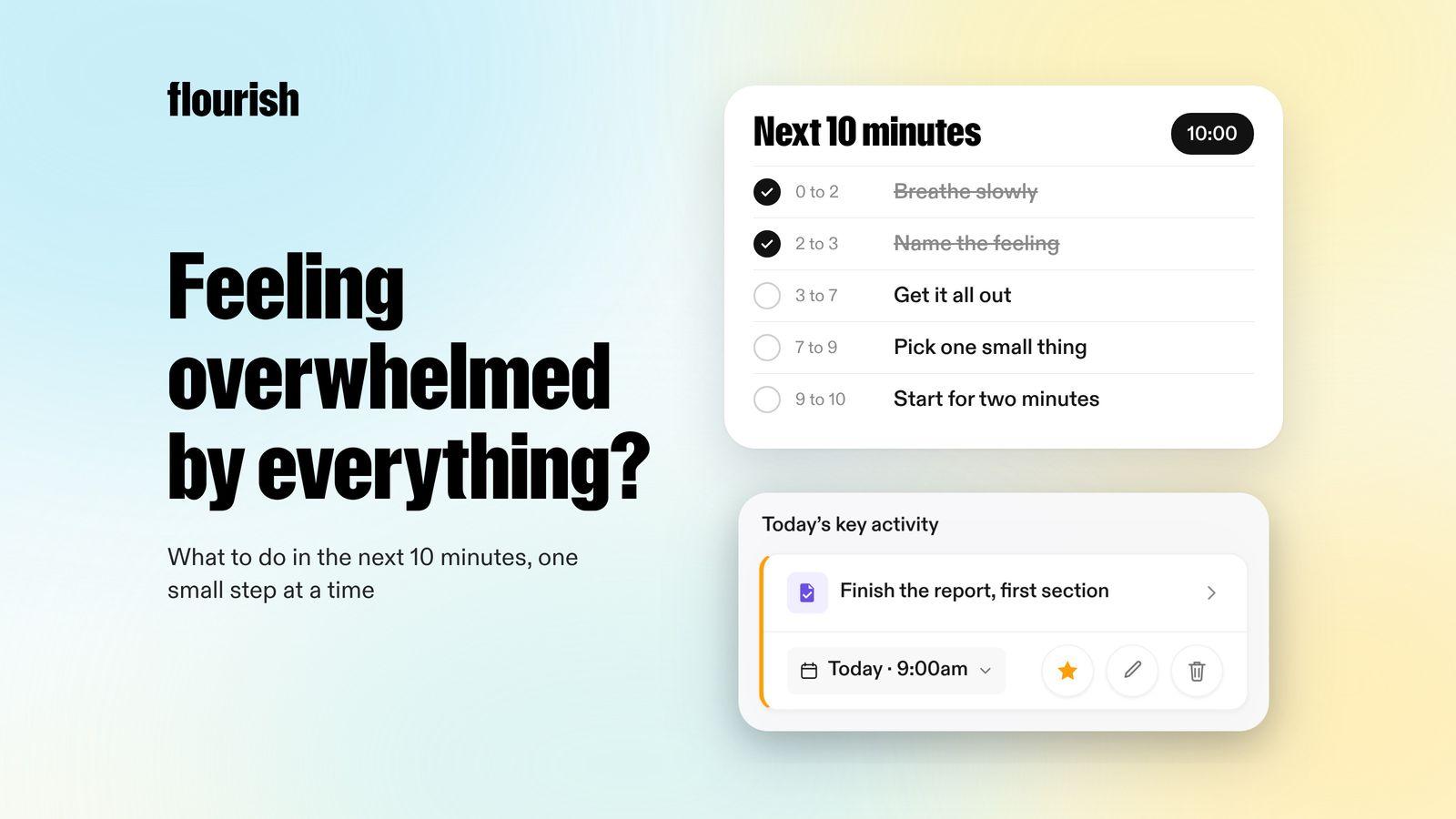
When you feel overwhelmed by everything, do not try to fix everything. Take the next ten minutes and do five small things in order: breathe slowly for two minutes, name what you are feeling, get everything out of your head onto a page or into a voice note, pick one small task, and start it for just two minutes. Overwhelm comes from holding too much at once, so the goal is to put it down and find one next step, not to catch up. If you would rather talk it out, Flourish turns a spoken ramble into a prioritised list with one clear to-do for the day.
That is the whole plan. The rest of this guide explains why each step works, what to do with the rest of your day, and when overwhelm is a sign you need more support.
Why does everything feel overwhelming at once?
Overwhelm is what happens when the demands on you feel bigger than the room you have to deal with them. It is rarely one thing. It is the report, the dentist, the school form, the bill, the message you have not answered and the vague sense you have forgotten something, all arriving at once.
The NHS lists feeling swamped, trouble concentrating, worrying constantly and finding it hard to make decisions among the mental symptoms of stress. That last one matters. When everything feels urgent, every choice about what to do first becomes a decision, and a head full of decisions is exhausting before you have done a thing. Our guide to decision fatigue explains why choosing gets harder as the day goes on.
Much of the weight is invisible, too. Remembering, planning and keeping track all take effort even when nothing gets ticked off. If that sounds familiar, our guide to the mental load breaks down where it comes from.
So the fix is not to work faster. It is to lower the load on your head first, then make one decision instead of forty.
What to do in the next 10 minutes

Minutes 0 to 2: slow your breathing
Stop what you are doing and breathe. The NHS suggests a simple breathing exercise for stress: breathe in through your nose for a count of five, out through your mouth for a count of five, and keep going for a few minutes. Do not force it, and do not worry if you cannot reach five at first.
This is not about relaxing on demand. It is about giving yourself a short pause before you act, because decisions made in a panic tend to be the wrong ones, such as answering the easiest email instead of the thing that matters.
Minutes 2 to 3: name what you are feeling
Say it, or write it in one line: "I'm overwhelmed because I have too much on and I don't know where to start." It sounds too simple to help, but putting feelings into words seems to take some heat out of them. In a brain imaging study, Lieberman and colleagues found that labelling an emotion reduced activity in the amygdala, a part of the brain involved in alarm responses.
Naming it also separates the feeling from the facts. "Everything is a disaster" becomes "I have eight things to do and a short day". The second one is a problem you can work on.
Minutes 3 to 7: get everything out of your head
Set a four-minute timer and dump everything on your mind onto paper, a notes app or a voice note. Tasks, worries, things you must not forget, half-ideas. Do not sort it or judge it. Just get it out.
This is the step that does most of the work. Unfinished tasks keep nagging at you, and research by Masicampo and Baumeister found that making a plan for unfinished goals reduced the intrusive thoughts they caused. Once something is written down, your head no longer has to hold it. If you want the full method, our step-by-step guide on how to do a brain dump covers how to sort the list afterwards.
Talking is often faster than writing when you are overwhelmed, because it keeps up with racing thoughts.
Minutes 7 to 9: pick one thing and make it small
Look at the list and choose one task. Not the most urgent-sounding one, and not the easiest. Choose the one that would make today feel lighter if it were done, or the one with a real deadline.
Then shrink it until it feels almost too easy. "Do the tax return" becomes "find last year's login". "Sort the house" becomes "clear the kitchen table". A task you can picture yourself starting is a task you will start. The NHS advice on stress makes the same point: don't try to do everything at once, and set small goals you can actually reach.
Minutes 9 to 10: start for two minutes
Start the small task and tell yourself you only have to do two minutes. Most of the resistance sits at the start, so once you are moving it is usually easier to keep going. If you stop after two minutes, that is fine too: you have broken the freeze, and the next step is already clearer.
If you get stuck here repeatedly, our guide to ADHD paralysis has more ways to get started when every task feels equally urgent.
What to do with the rest of your day
Ten minutes gets you unstuck. These steps keep the overwhelm from building straight back up:
- Cross things off without doing them. Go back to your list and mark anything that does not need to happen this week. That pile is usually bigger than you expect.
- Hand something over. Is there one task someone else could do, or help with? Ask for it specifically: "Could you do the school pick-up on Thursday?" works better than "I need more help".
- Give your one thing a time. A task with a time slot is far more likely to happen than a task with a hope.
- Park the rest somewhere you trust. One list, one app or one notebook, so you know nothing is lost.
- Check in again at lunchtime. A two-minute look at the list, then pick the next one thing.
What not to do when you feel overwhelmed
Some things feel productive but make overwhelm worse:
- Reorganising your whole system. A new app, a colour-coded planner or a perfect spreadsheet can wait. Right now you need one next step.
- Ranking the entire list. Forty items means forty decisions. Choose one, then choose again later.
- Doing all the easy tasks first. Answering emails feels good, but the big task is still there at 4pm and the overwhelm comes back.
- Pushing through without a break. Working late on adrenaline usually means a worse tomorrow.
- Numbing it. The NHS warns against using alcohol, smoking or gambling to cope with stress, because they can make things worse.
What if feeling overwhelmed is your normal?
If you feel like this most days rather than now and then, the ten-minute plan still helps, but it is worth looking at why.
For many people it is the sheer amount they carry. Parents, carers and anyone running a household often hold an invisible list that never stops growing. For ADHD brains, overwhelm can come from every task feeling equally urgent, which makes it hard to know where to start. Our guide to the best ADHD apps for adults covers tools built around that.
Either way, the pattern is the same: too much in your head, and no single clear next step. A daily habit fixes more than an occasional rescue. A short brain dump each morning or evening, one chosen priority, and a quick check-in later in the day stop the pile from building up in the first place.
Where Flourish fits

Flourish is an AI coaching app built for exactly this moment. You talk, and ramble everything on your mind, without having to sort it first. Flourish turns that ramble into tasks, prioritises them, and gives you one clear to-do for the day, which also shows on your lock screen. In other words, it does the dump, the sorting and the picking for you.
Then Flourish helps with the part after the ten minutes. Its coach reaches out proactively to help you plan, to challenge what you are about to do next and to keep you accountable, so you are not relying on remembering to open an app when you are already overloaded. It connects your calendar, wearables and Gmail inbox, so it plans around the day you actually have. It is available on iOS and Android. If you are comparing options, our roundup of the best brain dump apps puts it alongside six others.
When is it more than feeling overwhelmed?
Everyone feels overwhelmed sometimes. If it has gone on for weeks, if your own efforts are not helping, or if it is affecting your sleep, mood, work or relationships, speak to your GP or a doctor. Talking to a friend, family member or health professional helps too, and in the UK you can call Samaritans on 116 123 at any time if you need someone to talk to. In the US, you can call or text 988.
If you ever feel unable to keep yourself safe, call 999 in the UK or 911 in the US, or go to your nearest emergency department.
The bottom line
When everything feels like too much, give yourself ten minutes instead of a new system. Breathe slowly, name what you are feeling, get everything out of your head, pick one small task and start it for two minutes. Then cross off what can wait, hand over what you can, and give your one thing a time. If you want help doing that every day, Flourish turns a spoken brain dump into one clear to-do and checks in so it happens.
This article is for general information and is not medical advice. If you are worried about your mental health, speak to your GP or a qualified clinician.
Frequently asked questions
What should I do first when I feel overwhelmed?
Pause and slow your breathing for a couple of minutes before you do anything else. Breathing in and out slowly, to a count of about five, gives you a moment to think rather than react. Then get everything on your mind out of your head and onto a page or into a voice note, and choose one small task to start.
Why do I feel overwhelmed by small tasks?
Small tasks rarely arrive alone. When dozens of them pile up, each one is another thing to remember and another decision about when to do it, and together they take up a lot of mental space. Getting them all written down in one place, then picking just one, usually makes them feel small again.
How do I stop feeling overwhelmed at work?
Write down everything you have on, then choose the one task that matters most today and give it a time slot. Shrink it to a first step you can start in two minutes. Batch the small things like emails into one slot later, and be specific when you ask for help or a deadline change. Check in with your list again at lunchtime.
Can an app help when I feel overwhelmed?
Yes, if it reduces decisions rather than adding them. A long list app can make overwhelm worse by showing you everything at once. An app such as Flourish lets you talk through everything on your mind, then sorts it, prioritises it and gives you one clear to-do for the day, with a coach that checks in afterwards.
When should I get help for feeling overwhelmed?
Speak to your GP or a doctor if the feeling has lasted for weeks, if your own efforts are not helping, or if it is affecting your sleep, mood, work or relationships. In the UK, Samaritans are available on 116 123 day or night, and in the US you can call or text 988. In an emergency, call 999 or 911.
Keep reading

Julian
Flourishing Writer