How to Stay Consistent With Health Goals When Life Gets Busy
Busy weeks do not break health goals; all-or-nothing plans do. Here is how to stay consistent: shrink the goal, tie it to a fixed moment, track it simply, plan for the bad weeks and get someone to check in.
By Julian · · 8 min read
The short version
To stay consistent with health goals when life gets busy, make the goal small enough to survive your worst week, tie it to a fixed moment in your day, track it in the simplest way you can, decide in advance what you will do when the week falls apart, and get someone, or something, to check in with you. Consistency comes from a plan that bends, not from more willpower. Missing a day is normal; what matters is coming back the next one.
If the problem is that your health goals keep slipping behind work, family and everything else, Flourish can help. You talk through everything on your mind, it turns that into a prioritised plan with one clear to-do for the day, and a coach checks in so the walk, the workout or the early night does not quietly drop off.
Why do health goals slip when life gets busy?
Most health goals are set on a good week. You plan five gym sessions, perfect meals and eight hours of sleep, then a deadline, a sick child or a late train arrives and the plan breaks. Once it breaks, it feels easier to restart on Monday than to do a smaller version today.
Three things usually sit underneath that:
- The goal is too big for a normal week. A plan that only works when nothing goes wrong will fail most weeks.
- The goal has no fixed moment. "Exercise more" competes with everything else for space in the day, and the urgent things win.
- Nobody notices when it slips. Work has deadlines and family has people waiting. Your health goal usually has neither.
Busy weeks are also full of decisions, and decisions wear you out. By the evening, choosing between a run and the sofa is one more decision than you have left. Our guide to decision fatigue explains why choosing gets harder as the day goes on.
Seven ways to stay consistent with health goals

1. Shrink the goal to fit your worst week
Set a minimum you could still hit on a terrible day: a ten-minute walk, two glasses of water before lunch, phone off by 11pm. Keep the bigger target as a stretch, but make the minimum the thing you never skip.
It helps to know what "enough" looks like. The NHS suggests adults aim for 150 minutes of moderate activity a week, or 75 minutes of vigorous activity, plus strength exercises on at least two days. Spread over the week, that can be a brisk 20 to 25 minutes a day. That is a realistic target for a busy life, not a heroic one.
2. Tie it to a fixed moment with an if-then plan
Instead of "I will exercise more", decide exactly when and where: "When I drop the kids at school, I will walk the long way home." "If it is 6pm on Tuesday, I go to the gym before I go home."
These are called implementation intentions, and they have strong evidence behind them. A meta-analysis of 94 tests by Gollwitzer and Sheeran (2006) found that if-then plans had a medium-to-large effect on reaching goals. The plan takes the decision out of the moment, so you are not choosing when you are tired.
3. Expect it to take a couple of months
Habits take longer than the "21 days" myth suggests. In a study led by Phillippa Lally at UCL, it took participants an average of 66 days for a new daily behaviour to feel automatic, and the time varied a lot between people. If week three still feels like effort, nothing is wrong. You are just not there yet.
4. Do not let one missed day become a missed month
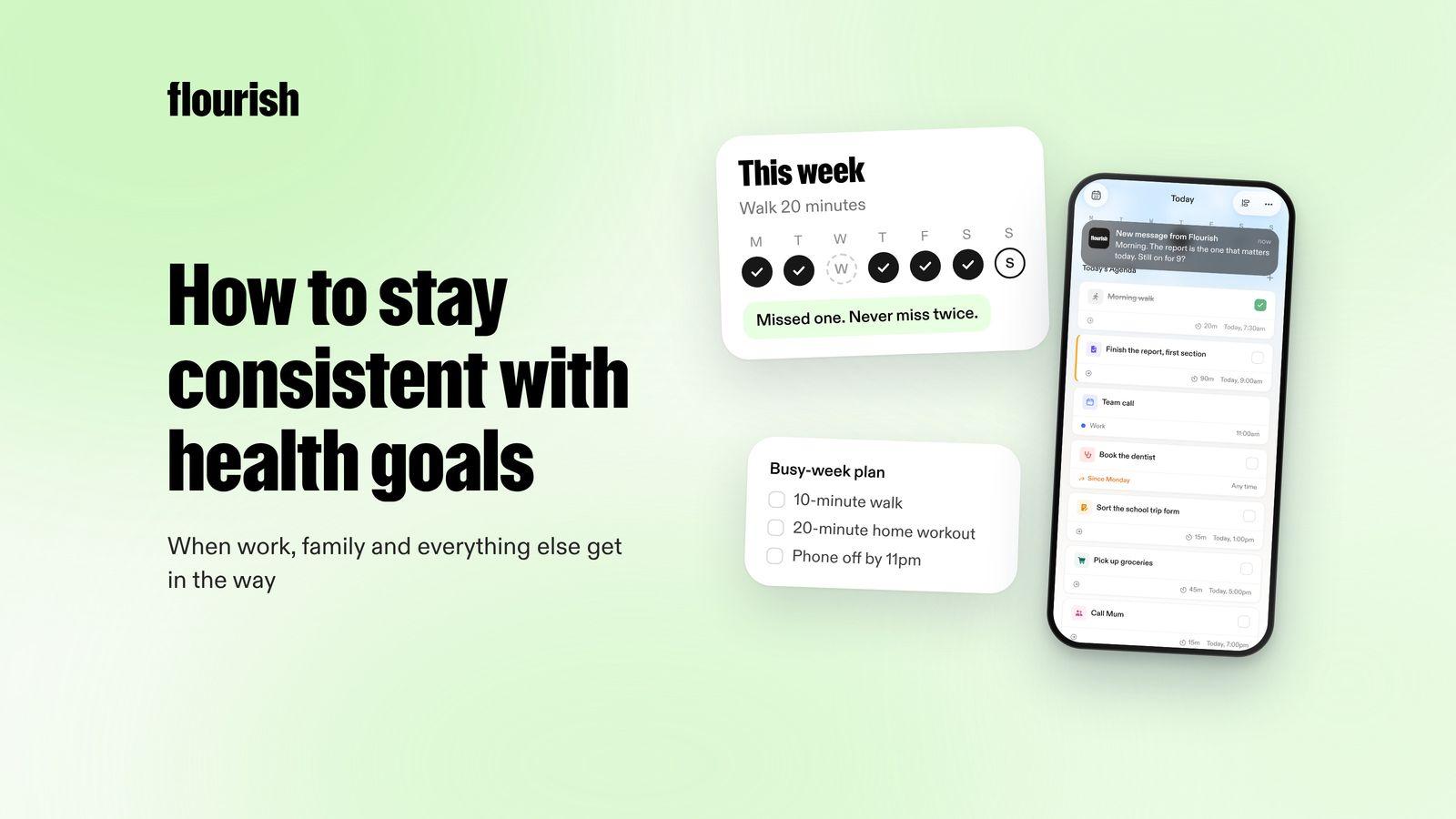
The same UCL research found that missing one opportunity did not significantly affect habit formation. What did matter was being very inconsistent. So treat a missed day as a missed day, not a failure. The rule many people find useful: never miss twice in a row.
5. Track it, simply
Monitoring works. A meta-analysis of 138 studies, mostly on health goals, found that people who monitored their progress were more likely to reach their goals, especially when they wrote results down or reported them publicly. The tracking does not need to be fancy. A tick on a calendar, a step count or a quick note is enough. If you have a wearable, let it do the counting for you.
6. Plan for the bad week before it arrives
Write a short "busy week" version of your plan now, while you are calm. For example: workouts drop from four to two, the two are 20 minutes at home, and meals are the three easy dinners you can cook on autopilot. When the bad week comes, you switch plans instead of abandoning them.
7. Get someone to check in
Goals with nobody watching are the first to slip. A friend you walk with, a class you have booked, a coach or an app that asks how it went all add a small outside reason to follow through. Our guide to AI accountability partner apps compares the options, from body doubling to apps that put money on the line.
Where Flourish fits

The hardest part of a health goal on a busy week is often not the workout itself. It is fitting it in around everything else in your head. Flourish is an AI coaching app built for that. You talk, and ramble everything on your mind, from work deadlines to the school run to "I keep meaning to get back to running". Flourish turns that into tasks, prioritises them and gives you one clear to-do for the day, which also shows on your lock screen.
Then the coach follows up. Flourish reaches out proactively to help you plan, to challenge what you are about to do next and to keep you accountable, so your health goal gets a place in the day instead of being the thing that slides. It connects your calendar, wearables and Gmail inbox, so it plans around the day you actually have.
It does not replace a personal trainer, a dietitian or your doctor. What it does is the part they cannot: noticing on Wednesday that the week is getting away from you, and helping you choose the smaller version instead of nothing. If you are weighing up AI support against a person, our comparison of AI life coaches and human life coaches sets out the trade-offs honestly.
A simple weekly routine for busy people
- Sunday, 10 minutes: look at the week ahead and pick your sessions. Put them in your calendar like meetings.
- Each morning: get everything out of your head (our guide on how to do a brain dump shows how) and check today's health minimum is still in the plan.
- Each evening: one tick or one note. Did the minimum happen?
- When the week breaks: switch to the busy-week plan, not to "Monday".
What not to do
- Do not restart on Monday. Restart with the smallest version today.
- Do not stack five new habits at once. Add one, keep it for a few weeks, then add the next.
- Do not rely on motivation. Motivation is strongest when you set the goal and weakest when you need it.
- Do not punish yourself for a missed day. Guilt makes it easier to avoid the goal, not easier to return to it.
The bottom line
Staying consistent with health goals on busy weeks is less about discipline and more about design. Make the goal small enough to survive a bad week, tie it to a fixed moment, track it simply and plan the busy-week version in advance. Then add something that checks in. If your health goals keep losing out to everything else in your head, Flourish helps you fit them into a realistic day and follows up so they stick.
This article is for general information and is not medical advice. If you have a health condition, are starting a new exercise programme or are making big changes to your diet, speak to your GP or another qualified professional first.
Frequently asked questions
How do I stay consistent with exercise when I am busy?
Set a minimum you could do on your worst day, such as a ten-minute walk, and tie it to a fixed moment in your routine with an if-then plan. Book sessions in your calendar like meetings, track them with a simple tick, and have a shorter busy-week version ready. Missing one day is fine; try not to miss two in a row.
How long does it take for a health habit to stick?
Longer than the 21 days often quoted. In a UCL study led by Phillippa Lally, it took participants an average of 66 days for a new daily behaviour to feel automatic, with wide variation between people. Expect a couple of months of effort, and do not worry if a habit still feels hard after a few weeks.
What should I do after I fall off track?
Start again with the smallest version of the goal today, rather than waiting for Monday. Research on habit formation found that missing a single opportunity did not significantly affect progress. Look at what knocked you off course, adjust the plan so it fits that kind of week, and get back to your minimum.
Do accountability partners help with health goals?
Often, yes. Research on goal monitoring found people were more likely to reach their goals when they tracked progress, especially when they reported it publicly. A friend, a booked class, a coach or an app that checks in all add an outside reason to follow through on the days you would otherwise skip.
Can an AI coach help me stay consistent?
An AI coach can help with the parts that break down on busy weeks: fitting the goal into your day, reminding you of it and checking in when things slip. Flourish, for example, turns a spoken brain dump into one clear daily priority and follows up. It is not a substitute for medical advice or a qualified trainer.
Keep reading

Julian
Flourishing Writer