AI Life Coach vs Human Life Coach: An Honest Comparison
What an AI life coach does well, what a human life coach does better, what the research says, and how to decide which one you need, or whether to use both.
By Julian · · 8 min read
The short version
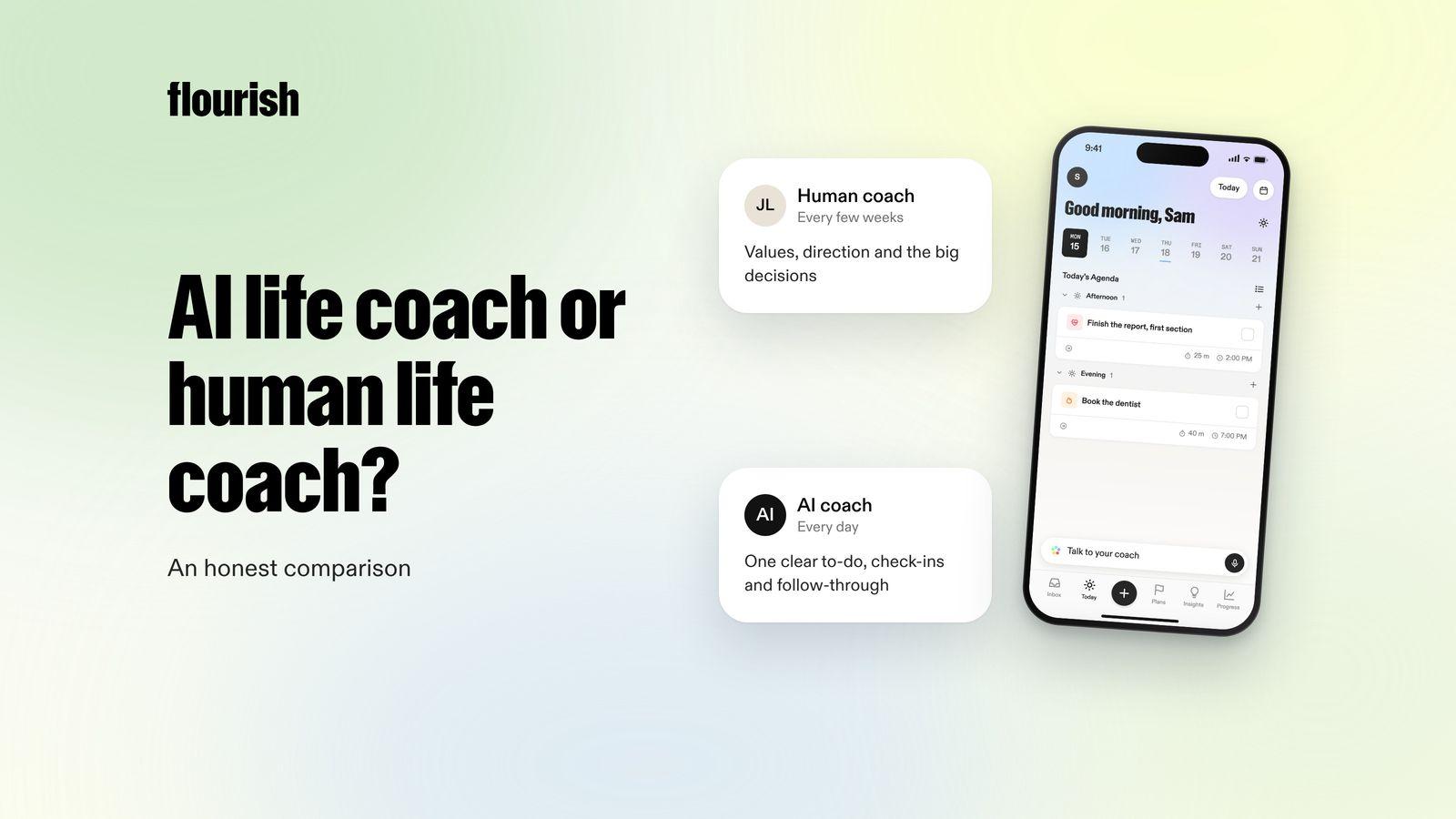
An AI life coach is as good as a human one for some jobs and not for others. For day-to-day goal work (setting goals, planning, checking in and keeping you accountable) a well-designed AI coach can match a human: one 10-month study found an AI chatbot coach helped people reach their goals about as well as human coaches. For deeper work, such as values, big life decisions, relationships or anything emotionally heavy, a skilled human coach is still better, because they bring empathy, judgement and context an AI does not have. Many people get the most from both: an AI coach like Flourish for the daily follow-through, and a human for the occasional deep session.
The question is usually framed as a contest. In practice it is more like asking whether you need a personal trainer or a fitness app. They are good at different things, and the right answer depends on what is actually stopping you.
What does a life coach actually do?
The International Coaching Federation defines coaching as "partnering with clients in a thought-provoking and creative process" that helps them reach their personal and professional potential (ICF). In practice, a life coach helps you get clear on what you want, turn it into goals and a plan, notice what gets in the way, and keep going. Coaching is not therapy: it is about moving forward, not treating mental health conditions.
That breaks down into a few jobs, and AI and humans are not equally good at all of them:
- Clarity: working out what you actually want.
- Planning: turning it into goals and next steps.
- Follow-through: checking in, nudging and holding you to it.
- Reflection: noticing patterns and adjusting.
- Depth: values, identity, relationships and hard decisions.

What does the research say?
The best-known comparison is a pair of 10-month randomised controlled trials published in PLOS ONE (Terblanche and colleagues, 2022). The first tested human coaches. The second repeated the study with an AI chatbot coach built on goal-setting theory, which helped people set realistic goals, build action plans and check in on progress. In both studies, coached participants reached their goals significantly better than control groups, and by the end the AI coach was about as effective as the human coaches, which the authors called unexpected.
There are important caveats. Goal attainment was self-reported, the two groups were separate studies rather than one head-to-head trial, and the AI coach was a narrow, scripted system focused only on goals. The authors are clear that AI currently lacks the empathy and emotional intelligence of a human coach, and that deeper, more complex coaching is still human territory. Their explanation for the AI's results is telling: it applied good goal-setting practice consistently, every time, including regular check-ins.
That is the real lesson. Much of what makes coaching work is consistency, and consistency is something software is good at.
Where an AI life coach wins
- It is there when you need it. Morning, midnight or in the car park before a hard conversation, not just at a booked session.
- It checks in often. Daily follow-up is where people tend to fall off, and an AI coach can check in every day without it becoming awkward.
- It is consistent. It does not have off days, forget what you said last week or skip the check-in.
- It lowers the barrier. Some people find it easier to be honest with an app, especially when they are behind on everything.
- It connects to your day. A good AI coach can see your calendar and tasks, so its advice fits the day you actually have.
Where a human life coach wins
- Empathy and rapport. A human can hear what you are not saying and respond to how you feel, not just what you type.
- Judgement on hard questions. Career changes, relationships and values-level decisions benefit from a person who can challenge you with real-world experience.
- Context and nuance. A good coach can connect patterns across your life that do not show up in a task list.
- Accountability with a face. For some people, not wanting to let a real person down is the strongest motivator there is.
- Knowing the limits. A trained coach can recognise when something needs a therapist or doctor and help you get there.
Side by side
- Availability: AI coach: any time. Human coach: scheduled sessions.
- Check-ins: AI coach: daily, proactive. Human coach: usually between sessions, if at all.
- Consistency: AI coach: high. Human coach: depends on the coach.
- Empathy and rapport: AI coach: limited. Human coach: strong.
- Deep or emotional topics: AI coach: not the right tool. Human coach: yes, within coaching limits.
- Connected to your day: AI coach: can see calendar and tasks. Human coach: only what you bring.

Flourish: an AI coach built for the daily follow-through

Flourish is an AI coaching app built around the jobs AI does best. You talk, and ramble everything on your mind. Flourish turns that brain dump into tasks, prioritises them and gives you one clear to-do for the day, which also shows on your lock screen. Then the coach reaches out proactively to help you plan, to challenge what you are about to do next, and to keep you accountable, so you do not have to remember to open it.
Flourish connects your calendar, wearables and Gmail inbox, so its check-ins fit your real day rather than an ideal one. It is available on iOS and Android.
- Best for: people who know roughly what they want but lose the thread day to day.
- Honest limitation: it is not a substitute for a human coach on deep, values-level questions, and it is not therapy.
If you want to compare other AI coaching apps, our guide to the best AI life coach apps covers seven, including whether ChatGPT can do the job.
Which one do you need?
- "I know what I want, I just do not follow through." Start with an AI coach. Daily check-ins and one clear priority are the gap.
- "I do not know what I want." Start with a human coach. Clarity on values and direction is where a person adds most.
- "I am facing a big decision or a hard season." A human coach, and a therapist or doctor if your wellbeing is suffering.
- "I have a human coach but lose momentum between sessions." Use both. An AI coach can carry the plan from one session to the next.
- "I have tried apps and ignored them." Look for an AI coach that reaches out first, rather than another app you have to remember to open. Our guide to AI accountability partner apps compares the options.
If your goals sit around focus and follow-through rather than life direction, the comparison of an ADHD coach and an AI coach goes into that in more detail.
Can you use an AI coach and a human coach together?
Yes, and for many people it is the best of both. A common pattern is a human session every few weeks for the big picture, with an AI coach handling the daily layer: turning the session's decisions into tasks, picking today's priority and checking in. Bring what the AI coach saw (what you did, what slipped) to the human session, and the conversation starts from facts rather than memory. If planning is the part you want help with, our roundup of AI planner apps covers tools built for that.
The verdict
An AI life coach is not a worse human coach. It is a different tool. For consistent, everyday goal work and accountability, the evidence suggests a well-designed AI coach can do about as well as a person, and it is there every day. For empathy, judgement and the deep questions, a human coach is still the right choice. If follow-through is what holds you back, Flourish is our pick for the daily layer, and a human coach is worth adding when the questions get bigger.
Frequently asked questions
Is an AI life coach as good as a real life coach?
For goal-focused coaching, it can be. A 10-month study found an AI chatbot coach helped people reach their goals about as well as human coaches, mainly because it checked in consistently. For deeper work on values, relationships or emotional challenges, a human coach is still better, because AI lacks real empathy and lived judgement.
What can a human life coach do that AI cannot?
A human coach can build genuine rapport, read emotion and what is left unsaid, challenge you from real-world experience and help with complex, values-level decisions. A trained coach can also recognise when an issue needs a therapist or doctor. AI coaches are better at availability, consistency and daily check-ins than at depth.
Can ChatGPT be my life coach?
ChatGPT can help you think through goals and draft a plan if you prompt it well. It mostly responds when you open it and ask, so it does not keep track of your goals or check in the way a coaching app built for that does. Dedicated AI coaches like Flourish reach out proactively and connect to your calendar.
Is an AI life coach the same as therapy?
No. Coaching, whether human or AI, is about goals, plans and follow-through, not diagnosing or treating mental health conditions. If you are struggling with your mood, anxiety or wellbeing, speak to your GP, a therapist or another qualified professional. An AI coach can sit alongside that support, but it should not replace it.
Should I use an AI coach and a human coach together?
Many people do. The human coach handles the big picture in occasional sessions, and the AI coach handles the daily layer: turning decisions into tasks, picking today's priority and checking in. That keeps momentum between sessions and gives the human coach a clearer picture of what actually happened.
This article is for general information. Coaching is not a substitute for medical or psychological care.
Keep reading

Julian
Flourishing Writer