ADHD Organisation: Tools and Tips for Getting Your Life in Order
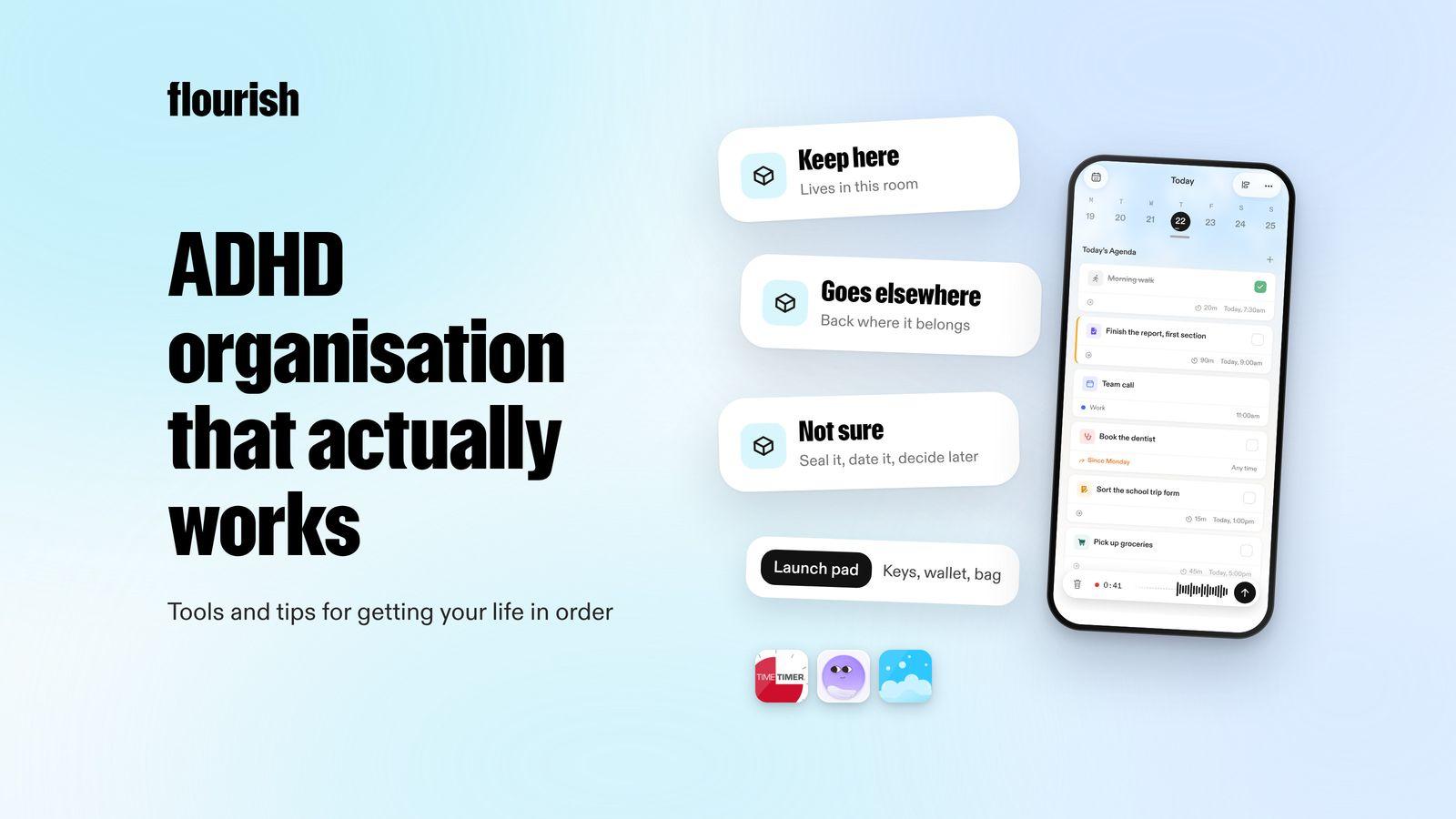
ADHD organisation works best when it is built around how ADHD brains actually work: one place for everything in your head, things kept visible, short sessions, a launch pad by the door and one clear priority a day.
By Julian · · 8 min read
The short version
The best way to get organised with ADHD is to stop relying on memory and willpower and build a few simple systems outside your head. Keep one place for everything you need to remember, keep important things visible, tidy in short timed bursts, set up a launch pad by the door for keys and bags, and choose one clear priority each day instead of facing a long list. Organisation with ADHD is not about becoming a naturally tidy person. It is about making the right thing the easy thing.
The right tools help. A brain dump app such as Flourish turns everything on your mind into a prioritised plan with one clear to-do for the day, a visual timer makes tidying sessions finite, and a chore app can share the housework. This guide covers the tips first, then the tools.
Why is getting organised so hard with ADHD?
The NHS lists finding it hard to organise your time, struggling to finish tasks and losing things like your wallet, phone or keys among the symptoms of ADHD in adults. CHADD notes that getting and staying organised is a real challenge for many adults with ADHD, and that clutter at home and work can leave people feeling overwhelmed or stuck.
That is not a character flaw. Organising draws on executive functions such as planning, working memory and starting tasks, which are exactly the skills ADHD makes harder. Three patterns tend to cause most of the trouble:
- Out of sight, out of mind. If you cannot see it, it stops existing, so things put away neatly get forgotten.
- Too many decisions. Every item you pick up asks "where does this go?", and a cluttered room asks hundreds of times.
- All or nothing. Waiting for a free weekend to sort everything means it never starts. Our guide to ADHD paralysis explains why big vague tasks freeze you.
The tips below are designed around those three patterns.
Nine ADHD organisation tips that actually work

1. Have one inbox for your head
Pick one place where everything you need to remember goes: tasks, appointments, ideas, worries. One app or one notebook, not five. When your head is the filing system, you will forget things and feel anxious about forgetting them. Empty it once a day; our guide on how to do a brain dump shows how. Talking it out is often faster than writing when your thoughts are racing.
2. Choose one priority a day
A long to-do list looks organised but often leads to doing the easiest thing. Each morning, pick the one task that would make the day feel worthwhile and do that first. Everything else is a bonus.
3. Keep important things visible
Work with "out of sight, out of mind", not against it. Use open shelves, clear boxes and hooks instead of drawers and cupboards for things you use daily. Put the medicine next to the toothbrush, the library books by the door, the forms on the fridge.
4. Set up a launch pad by the door
CHADD suggests a launch pad: a table, shelf or basket by the front door where keys, wallet, bags and anything leaving the house always live. It ends the morning hunt and gives every "where did I put it?" item a single answer.
5. Tidy in short, timed bursts
CHADD recommends working in short sessions, 30 to 60 minutes, or 10 to 15 if you tire quickly, with a timer or a playlist to mark the end. Start with the easiest space, not the worst one, so you get a quick win. A visual timer makes the session feel finite, which makes it easier to begin.
6. Sort into three boxes
When you tackle a space, split it into sections and work one at a time. CHADD's method is simple: "keep here", "goes somewhere else" and "not sure", plus a bin bag. Seal the "not sure" box, date it three to six months ahead, and if you have not needed anything in it by then, let it go. This turns hundreds of decisions into three.
7. Handle paper once
Paper piles grow because every letter is a decision you postpone. CHADD's four options cover almost everything: throw it away, pass it to someone else, act on it now or file it. Anything with a date goes straight into your one inbox.
8. Use a body double
Body doubling means working on your task while someone else is nearby. ADDA describes it as working alongside someone else, whose quiet presence creates accountability. A friend on a video call, a family member in the room or an online coworking session can turn "I'll sort the spare room one day" into an hour that actually happens.
9. Subtract before you add
Clutter grows faster than you can sort it. CHADD suggests removing an item before bringing a new one in. The same works for commitments: before you say yes to something new, decide what you will drop.
Tools that help with ADHD organisation
You do not need lots of apps. Pick one for each job that is causing you trouble.
Flourish: for organising what is in your head

Flourish is an AI coaching app for ADHD brains with a million things going on. It is the one inbox from tip 1 and the one priority from tip 2 in a single app. You talk, and ramble everything on your mind. Flourish turns that into tasks, prioritises them and gives you one clear to-do for the day, which also shows on your lock screen, so it stays visible.
Then the coach follows up. Flourish reaches out proactively to help you plan, to challenge what you are about to do next and to keep you accountable. It connects your calendar, wearables and Gmail inbox, so appointments and emails land in the same plan. It does not tidy your house, but it takes the remembering and deciding off your mind, which is where disorganisation usually starts.
A task breaker: for jobs too big to start
"Sort the garage" is not a task; it is a project. Tools such as Goblin Tools break a vague job into small, concrete steps. Our guide to Goblin Tools alternatives compares apps that do this.
A visual timer: for short, finite sessions
Time Timer shows time as a red disk that shrinks as the minutes pass, on iPhone, iPad, Mac and Apple Watch (Time Timer on the App Store). It is ideal for tip 5. For more apps that make time visible, see our guide to ADHD time management apps.
A visual planner: for seeing the day
Tiimo turns your schedule into a visual timeline, with an AI co-planner that breaks plans into steps and estimates how long each step may take (Tiimo). It suits people who need to see the day to manage it.
A chore app: for the house
Sweepy builds a cleaning schedule around the time you have, shows how clean each room is, and lets you share chores with the people you live with (Sweepy). It turns "the house is a mess" into a short list for today.
How to start this week
Do not try all nine tips at once. That is the all-or-nothing trap again. Try this instead:
- Today: set up your one inbox and empty your head into it.
- Tomorrow: put a basket by the door and make it the launch pad.
- This weekend: one 15-minute timed session on the easiest space in your home, using three boxes.
- Every morning after that: choose one priority before you open anything else.
If a long list is still the thing that stops you, our guide to the best to-do list app for ADHD compares apps that keep it short.
The bottom line
ADHD organisation works when it stops depending on memory and willpower. Keep one place for everything in your head, keep important things visible, tidy in short timed bursts, give your keys a launch pad and choose one priority a day. Then use one or two tools to carry the load. If the mess starts in your head, Flourish turns a spoken brain dump into one clear priority and checks in so it gets done. For a wider look at what helps, see our guide to the best ADHD apps for adults.
This article is for general information and is not medical advice. If ADHD symptoms are affecting your daily life, speak to your GP or another qualified professional about assessment and support.
Frequently asked questions
How can I get organised with ADHD?
Build simple systems outside your head instead of relying on memory. Keep one place for everything you need to remember, keep important things visible, set up a launch pad by the door, tidy in short timed sessions and pick one priority each morning. Start with one change this week rather than trying to fix everything at once.
Why is it so hard to stay organised with ADHD?
Staying organised depends on executive functions such as planning, working memory and starting tasks, which ADHD makes harder. The NHS lists difficulty organising time and losing things among adult ADHD symptoms. Out of sight often means out of mind, and every item in a cluttered space asks for a decision, which is tiring.
What is the best organisation app for ADHD?
It depends on what needs organising. For the tasks and worries in your head, Flourish turns a voice brain dump into one clear to-do with a coach that checks in. For seeing your day, Tiimo shows it as a visual timeline. For the house, Sweepy builds a cleaning schedule you can share with the people you live with.
What is a launch pad for ADHD?
A launch pad is a fixed spot by your front door, such as a table, shelf or basket, where keys, wallet, bags and anything leaving the house always go. CHADD suggests it as a simple way to stop losing everyday items and to make leaving the house in the morning less stressful.
How do I declutter with ADHD when I feel overwhelmed?
Start small and make decisions easy. Set a timer for 10 to 15 minutes, begin with the easiest space, and sort items into three boxes: keep here, goes somewhere else and not sure, plus a bin bag. Seal and date the not sure box so you do not have to decide today.
Keep reading

Julian
Flourishing Writer